To Tell the Whole Story
In September 1972, before Richard Nixon’s reelection, the Smithsonian Institution’s National Museum of American History (NMAH) opened an exhibit titled The Right to Vote. This exhibit was designed to mark the 1971 ratification of the Twenty-Sixth Amendment to the US Constitution that lowered the voting age to eighteen. Edith Mayo, recently appointed to a post in the Political History Division, was assigned to the project. As curatorial assistant, she gathered materials for the exhibit from the campaigns of Nixon, George McGovern, and Shirley Chisolm. But her vision was broad and stretched beyond traditional political campaigns. Despite the disapproval of the museum’s director, Daniel Boorstin, she sought out materials that would highlight historic struggles to expand American democracy. Indian rights activists of the Menominee nation who had launched a get out the Indian vote campaign for 1972 and Black civil rights activist John Lewis of the Voter Education Project responded enthusiastically. Lewis donated materials and his organization funded an exhibit catalog — something the museum was unwilling to do. The exhibit featured material on woman suffrage, too. Overall, under Mayo’s guidance, the exhibit reflected the diverse voting rights groups who spoke out, organized, marched, picketed, went on hunger strikes, and were ridiculed, assaulted, and jailed for their efforts before achieving their goals over the course of the 20th century.
The exhibit was due to run until the beginning of February 1973. It was closed early, before Nixon’s second inauguration on January 20, 1973. Mayo explained:
That, of course, was the election where the Committee to Reelect the President was doing all of its nefarious deeds [for example, the Watergate break-ins] … The people from CREEP [Committee to Re-Elect the President] bodily migrated into the inaugural committee. When they came to sort of “case the place” for the inaugural ball and inaugural festivities, which they had had a tradition of holding at the [National Museum of American History], and the Air and Space Museum, and the Kennedy Center, . . . and saw this “Right to Vote” show they just about freaked out, and went to the assistant director, and said that this show was too controversial for good Republicans to see, and they closed it during the inaugural week, and it remained closed until the end of January when it came down … They physically closed the exhibition. I was called into the assistant director’s office and told if I went to the Washington Post I would lose my job … They [members of Nixon’s inaugural committee] were appalled by sights of women picketing in front of the White House, and Blacks on the march at Selma, and Indians voting! … If it hadn’t been so personally frustrating and traumatic for me it would have been a hoot . . . , but at the time it was pretty scary … Even my conservative colleagues thought it was a bit much to close the show … It was exactly like being on [Nixon’s] Enemies List. I felt I’d really arrived.
Mayo understood the negative reaction to the exhibit as an indication that the content hit home by challenging traditional conservative conceptions of whose history mattered. Conservative Republicans in the ascendant “New Right” took American history seriously, as both a reflection and a shaper of American culture. This example of their censure of the new social and political histories of women and people of color attests to how these histories undercut the ability of the Right to appeal to American voters through uncritical renderings of the nation’s past. Prior to the 1960s, traditional history narratives, including those featured in museums, were replete with American exceptionalism and focused on white male founders, leaders, and mavericks. They typically ignored America’s diversity, paradoxes and inequalities and the conflicts that featured prominently in much of the cutting-edge scholarship by the 1970s. To recenter history on women and marginalized racial, ethnic, sexual, and economic groups was, as Mayo perceived, a challenge to the powerful white men who had dominated the nation and its history since its founding. Mayo found her work at the Smithsonian to be in the political crosshairs of an increasingly polarized public discourse on American history and identity.
Mayo became a museum professional in the wake of the civil rights movement and at the height of the women’s liberation movement. She was eager to design historical exhibits featuring the contributions of women and people of color to American political history. But as a federal employee in the nation’s premier museum, she faced censure by political operatives opposed to presenting knowledge as it was being recast by women and minorities. Mayo claimed that she felt she had “really arrived,” when the Nixon inaugural committee targeted the content of her show. She knew she had created a political impact strong enough to provoke opposition; her work incorporating women and people of color mattered. Indeed, this episode foreshadowed history’s place in the culture wars of the late 20th century. Over the next two decades, Reagan Republicans of the New Right would make controlling or taking back the dominant historical narrative, defunding education, and starving agencies that supported social science research a key part of their political and cultural agenda. For them, the social, progressive, and radical history produced over the course of the 20th century was biased, too critical of America, too divisive, and unpatriotic. They moved to defund and dissolve the National Endowment for the Humanities and to defund the National Archives. They persistently attacked American educators in schools, colleges, and universities and attempted to restrict public access to the National Archives. These efforts continue to this day.
Heather Huyck also began work in public history in the early 1970s, She originally took a job as a seasonal park worker for the National Park Service in 1971, and by 1980 she was a content specialist in women’s history in the NPS — the only person in that position. A course at Carleton College had awakened her interest in women’s history. Then, as a graduate student at the University of Minnesota, she had been a field-worker on the Women’s History Sources Survey, the project that generated the reference work promoted by the Organization of American Historians’ Committee on the Status of Women and managed by Clarke Chambers and Andrea Hinding.
Huyck had a special fondness for historic landmarks and parks, having visited many in her childhood, which is why she chose to work in public history. While at the NPS, she developed an understanding of how to make women’s history a part of the nation’s public history. Beginning in the late 1970s, Huyck participated in public history sessions, workshops, and conferences at OAH meetings and at the Southwest Institute for Research on Women in Tucson. She trained public historians as interpreters at the NPS training center in Harpers Ferry, Virginia. In 1981, the NPS sent her to Seneca Falls, New York, the site credited as the birthplace of the American women’s rights movement, to consult on the early planning and development of the Women’s Rights National Historical Park.
The concept for the park had originated with local history groups, including the Seneca Falls Consortium and the Elizabeth Cady Stanton Foundation, and with scholars active in the Upstate New York Women’s History Organization (UNYWHO) in 1979. These groups lobbied Congress to establish the park in Seneca Falls.
Congress approved the legislation for the site in December 1980 but by 1982 still had not appropriated funds to build it or its programs. UNYWHO and the Seneca Falls Consortium mounted an intense lobbying campaign in support of adequate congressional appropriations for the park. In their efforts to raise money to purchase and renovate the Elizabeth Cady Stanton House and the Wesleyan Chapel, where the famous Declaration of Sentiments and Resolutions had been read in 1848, the Elizabeth Cady Stanton Foundation attracted a star-studded cast to its Honorary Trustees Board. These included star of the M*A*S*H TV series Alan Alda, feminist artist Judy Chicago, feminist activists Betty Friedan and Gloria Steinem, congresswoman Shirley Chisholm, presidential advisor Linda Johnson Robb, anthropologist Ashley Montague, and feminist theorist Adrienne Rich.
The new National Park Service superintendent warned that unless the Seneca Falls project could draw national attention to the prospective park, it would go the way of other federal programs for women, “archival oblivion.” In 1982, UNYWHO and the Seneca Falls Consortium mounted a major conference and festival in the village of Seneca Falls to give shape to the plans. Alan Alda attended the opening ceremony, bringing added national media attention to the event. The response from every corner of the women’s history movement was overwhelmingly positive.
A central figure in the initiatives for the Seneca Falls park was Judith Wellman, who from 1981 to 1983 served as the chair of the OAH Committee on the Status of Women. She was also a founder of UNYWHO. Her institutional connections helped her garner support from other academic women’s historians for this event. She’d been appointed to the OAH-CSW by Gerda Lerner, who along with Anne Firor Scott and Joan Hoff-Wilson were at the conference and collectively represented the OAH as current or former officers of that association. Heather Huyck represented the National Park Service; Patricia Miller King attended as director of the Schlesinger Library. Assistance was rendered from afar by the AHA’s Noralee Frankel and the Smithsonian Institution’s Anita Rapone and Edith Mayo. Betty Morgan of National Women’s History Week and Bettye Collier-Thomas of the Bethune Museum and the National Archives for Black Women’s History also participated. A dozen more leading scholars attended. Thus, this major public history initiative had the support of many individual scholars as well as more formal history institutions.
The Elizabeth Cady Stanton Foundation claimed success when on July 19, 1983, the 135th anniversary of the reading of the Declaration of Sentiments and Resolutions, Congress appropriated a half-million dollars for the Women’s Rights National Historical Park. New York senators Daniel Patrick Moynihan and Alfonse D’Amato drafted the appropriations bill. The Women’s Rights National Historical Park is still in operation to this day. Eventually both the Stanton House and site of the Wesleyan Chapel were purchased, restored, and put into operation as public history sites by the National Park Service. The NPS also acquired the Mary Anne M’Clintock House and the Hunt House in nearby Waterloo, New York, where two of the fomenters of the 1848 convention lived and planned their historic deeds.
Public historians and regional women’s history groups, like UNYWHO, an affiliate of the national Conference Group on Women’s History, reached beyond the ivory tower and national historical associations. By the early 1980s, these groups were bringing programs to schoolchildren, as with Minnesota’s Teaching Women’s History Center, and to the public, as with the Women’s Rights National Historical Park of the National Park Service. Scholars who was active across multiple professional associations, advanced women’s history in both the public and academic spheres. Academic work had public applications, and regional work had national ramifications. For Heather Huyck, who saw women’s history as a transformative and consciousness-raising force, the Women’s Rights National Historical Park was an exemplary outcome, reflecting her broader vision.
I was trying both to get park units to understand they had women’s history and to get more park units focused on women’s history. . . . We had a joke for a long time that there was one site where there was no women’s history. We thought it was Alcatraz, but then we found out that the wardens’ families lived there and the prisoners’ families visited. . . . So we always talked about the “Alcatraz principle” — that the only question is, “How hard do you want to look [for women] and how do you interpret it?,” not, “Were there women?”
Huyck’s consultation on Seneca Falls, which she saw as a “landmark theme study in women’s history,” was part of her larger intellectual project of integrating women into the interpretation of America’s historic places everywhere. She knew that women had a presence in all national monuments and parks. In 2001 she remarked,
The park system is now 383 units … everything from Constitution Gardens in DC to Yellowstone to Alcatraz … There’s women’s history all over the place. . . . The basic understanding I’ve always had was you had this national system of delivery, to put it into marketing terms. You have a built-in audience. We get [millions of] visitors a year, and you have quality [resources]. A more recent director of the Park Service said it was a huge campus, but what I’ve seen is it was an amazing set of resources and delivery to willing audiences “of who we are and where we came from.” If there’s a piece that’s core to me it’s that. Then the piece that’s right there in terms of my own background in women’s history is to tell the “whole story” at each and every one of these sites. So more recently I did a piece on women and the Civil War, and I said those battlefields were people’s farmyards. All the horrific stories of your dining room being taken over for surgery and the stories of the women who hid out in the caves of Vicksburg … and it’s a … civil war. It’s a domestic war and what does that mean? So, I’m much more conscious now of being able to say by using a feminist approach, by looking at the whole story and the women’s history, you get a totally different interpretation of what happened.
Huyck’s insight was that women’s history, when presented through the National Park Service, could reach millions of Americans who had scarce opportunity to study in a university. The tens of millions of park visitors each year represented an audience who would find in the parks an integrated view of women in history. This meant introducing women’s stories into existing sites as well as creating sites dedicated solely to women. Women’s historians — even as they struggled for legitimacy within academia — were keenly aware of the need to introduce their grand epistemological project to the broader public.
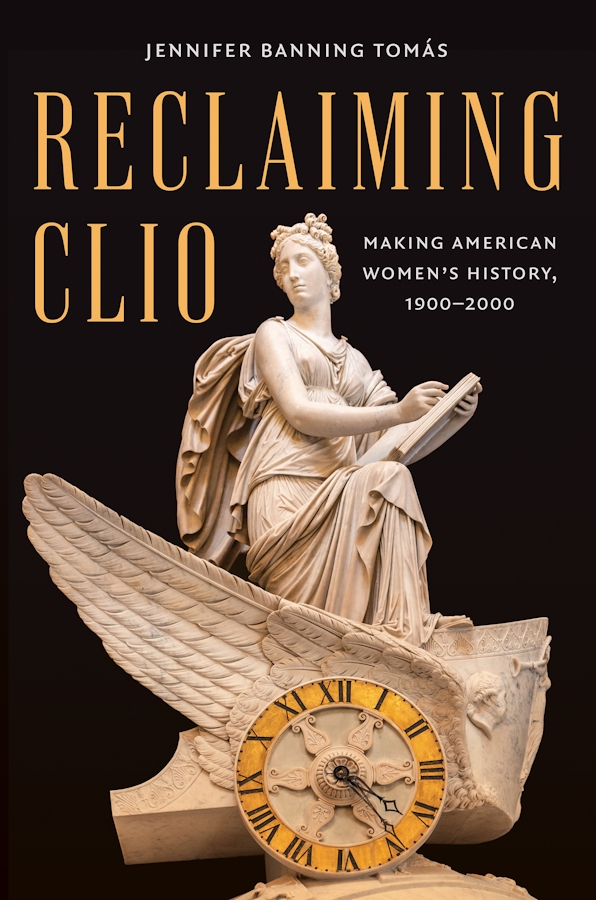
Excerpted from Reclaiming Clio: Making American Women's History, 1900-2000 by Jennifer Banning Tomás. Copyright © 2025 Jennifer Banning Tomás. Excerpted with permission of University of North Carolina Press. All rights reserved.