
What Has His Billion Dollars Made of Him?
Henry Ford, by Samuel Johnson Woolf, 1935. [National Portrait Gallery]
The similarities between Henry Ford and Elon Musk are too seductive to pass up. A car manufacturing magnate, untold wealth at his disposal, begins to lose his grip on reality. The media property he owns devolves further and further into antisemitic conspiracy theorizing. He lays off hundreds of workers and cuts the wages and benefits of the ones who stay. Politically connected by his wealth and the great mythology constructed around his personality, he begins to believe in his own intellectual genius — not just in the world of business, but in politics, economics, and society. This is the story of Musk and Ford, told in outlets from the New York Times to The American Prospect over the last few years, as Musk bent the site formerly known as Twitter to his own ends, rampaged through the federal government, and kept getting richer.
“People become king, and then they go crazy,” Elon Musk’s ex-wife Talulah Riley told his biographer. The same might be said of Ford, at least as he is fictionalized — with both an exacting rage and sympathy — in Upton Sinclair’s novel The Flivver King. “What is Henry Ford?” the front cover asks. “What have the years done to him? What has his billion dollars made of him?” Sinclair, the muckraking journalist-turned-politician-turned-novelist, wants to know. The Flivver King — named after the slang term for the cheap cars that made Ford famous — is literature meant to do politics. A partially fictionalized account of Ford’s and his workers’ trajectories, The Flivver King hews closely to Ford’s actual biography and to the trajectory of world events, though Sinclair’s own socialist politics are evident throughout.
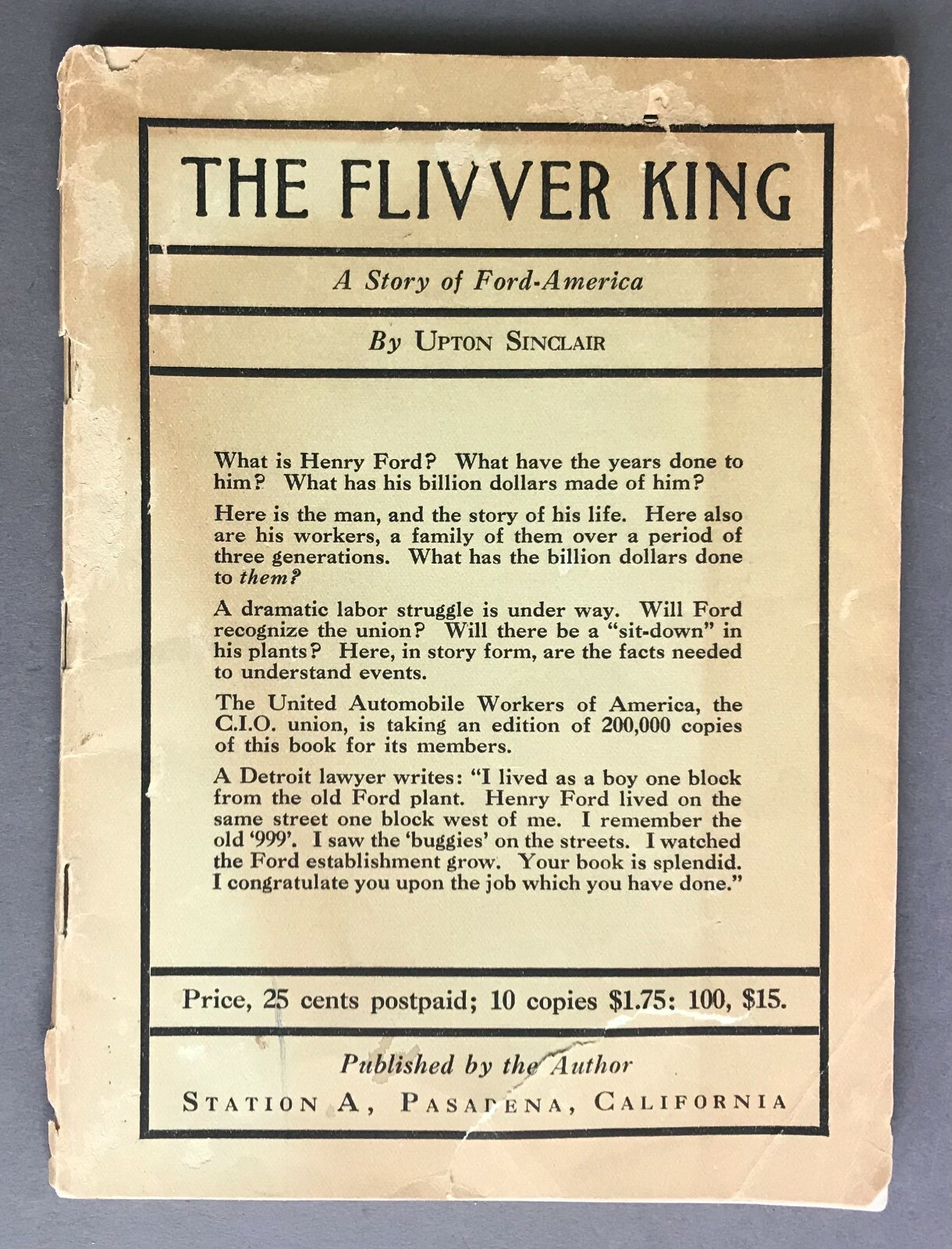
Self-published in 1937, the year of the newly formed United Auto Workers’ successful sit-down strike at General Motors, The Flivver King was written to aid a new UAW effort: organizing Ford plants. After partially serializing the novel in its newspaper, the union printed and distributed 200,000 copies across Detroit, handing them to Ford workers on their way into the job. The Flivver King was published just a few months after “the Battle of the Overpass,” when a young Walter Reuther and comrades were beaten up by Ford company thugs as they distributed union literature on the street corner, in a scene captured by a newspaper photographer that made headlines across the country. The UAW was scrappy and just two years old, up against a giant. It wasn’t at all clear who would win this battle.
The Flivver King is the story of the social, parasocial, and ultimately economic relationship between two men: Henry Ford and Abner Shutt, who helped Ford out of a tough spot on a gravel road when he was just an engineer with a horseless carriage that almost worked. For his troubles, Shutt eventually gets a job on Ford’s factory line making flivvers for the working man. “The horseless carriage was not a toy for the rich,” Sinclair’s Ford discovers, “but a useful article for everybody.” Not only does Ford produce cheap cars for everyday people, he pays his workers an unheard-of five dollars a day — or, if you read the fine print, two dollars and change supplemented by a profit-sharing scheme Ford workers benefit from if they pass the scrutiny of Ford’s Sociological Department, which “instilled” in Ford factory workers the virtues of cleanliness, Godliness, marriage, and prudence. To Shutt, Ford is the one who has made it, whose own hard work and ingenuity have elevated him to the top of his own, self-created business. He sees in Ford the image the automaker conscientiously projected since the beginning, an elite who cares.
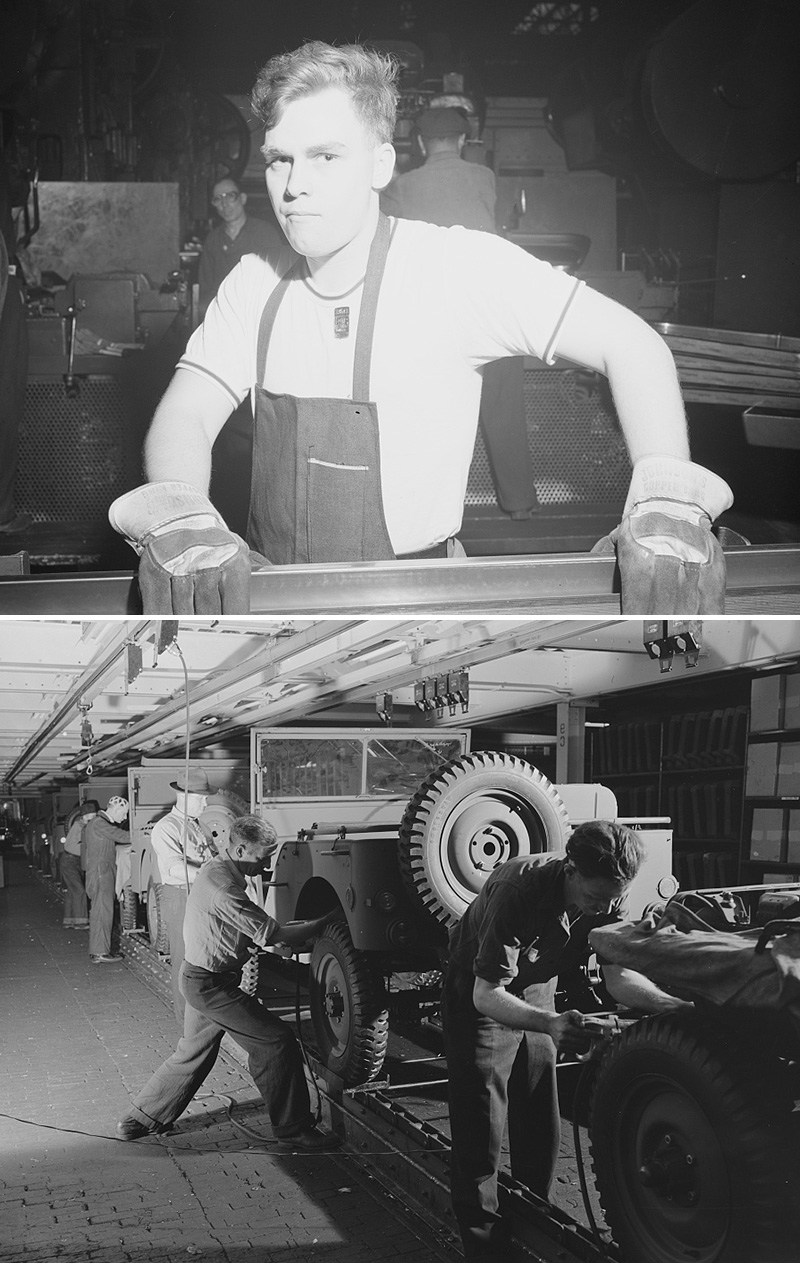
Bottom: Workers at the River Rouge Ford plant, 1941. Photograph by Alfred T. Palmer. [Library of Congress]
The novel proceeds through the Shutt generations, making an argument about the trajectory of industrial, factory-line capitalism. Abner Shutt’s father Tom worked in a rail freight car factory, hard labor and long hours that exhausted him — the kind of work that assembly-line Fordism claimed to disrupt. As they grow up and experience World War I, Prohibition, and the Depression, Abner’s children follow different paths. The oldest, John, becomes a manager on the line at Ford. He is laid off during the Depression and rehired at the wage he’d started at years earlier. The second, Hank, becomes a company thug after a life in organized crime — one of thousands such people hired, in reality, by Ford’s “Service Department” to keep its workers in line. Daisy, the daughter, becomes a secretary married to a bookkeeper laid off during the Depression. They are forced to move back in with Abner and his wife. The youngest, golden boy Tom, gets a football scholarship to college and becomes a union organizer. His first attempt at organizing is salting the very Ford plant at which his father worked. He is eventually found out and blacklisted, ratted out by his brother, Hank, named for Henry Ford and deep in the industrialist’s pocket. When the UAW comes to town looking to organize Ford Motor Co., Tom takes up the cause again, becoming a paid organizer for the new union.
Abner and his wife imagined a stable life of upward mobility when he became a sub-foreman at Ford nearly two decades earlier. They instead end up running a boarding house to make ends meet. After layoffs, and due to his age and factory line-induced injuries, Abner is stuck in a job worse than the one he’d first taken at Ford. Still, Abner does not blame the man at the top of the company, even as the lines run faster and the wages and benefits get worse. Instead, Abner — screwing more and more spindle-nuts into wheels on the line every day as processing speeds increase — thinks himself “one of the luckiest workers in America.” If Ford knew the reality of his factories, Abner believes, he’d care. Abner isn’t spared until his wife makes a secret plea to Clara Ford, asking her to look upon her husband’s grateful servant with favor.
Ford’s influence over his workforce is near-totalizing. “Both Henry and Abner continued to read the news of the world, and to interpret it, each according to his understanding,” Sinclair writes. “Strange as it might seem, their minds moved together, undergoing the same changes at the same time.” But it becomes clear that it is not so strange at all. Ford owned and controlled Abner’s sole source of information, The Dearborn Independent. Most famous outside the novel for publishing The Protocols of the Elders of Zion and a series called The International Jew, later published as a book, Ford’s Independent convinces Abner and many of his fellow workers that it is not his employer that is exploiting him, but rather an international cabal. Abner joins the Ku Klux Klan “to put down Jews, Catholics, Reds, and other alien enemies”; he burns crosses with them, and he is assured by his Klan brethren and by his employer, Henry Ford, that he is protecting “Protestant American Gentile civilization.” Controlling workers’ source of information is akin to controlling their minds.
About halfway through The Flivver King, the author himself appears in an attempted deus ex machina, a story taken and embellished from his own real life, to save the Dearborn working class. World War I has just ended, and Ford takes a trip to Altadena, California, where he meets a man whom the reader quickly realizes is Upton Sinclair. The pair speaks for hours about politics and the state of the world and find that they are not so different in their goals but diverge significantly in their means.
Sinclair then invites his friend, King C. Gillette, the CEO of Gillette Corporation, into the conversation. (This, too, is a scene that seems to be based on real events). King Gillette is, remarkably, a real person, the inventor of the disposable razor. The “Razor King” is a businessman with a very different kind of politics, a Utopian Socialist who enlisted Sinclair to help write his 1924 book, The People’s Corporation, the argument of which bleeds into The Flivver King in this strange interlude within Sinclair’s novel. Gillette dreams of a World Corporation operated in the public interest, with the public’s money, without need for competition or shareholders. Now an old man, he seeks to convince Ford to carry forward this dream.
But the Razor King is unable to convince the Flivver King to dedicate his vast power and wealth to the goal of creating a different future. Ford’s sympathies lie with the individual and the private, not the social and public. “It was like the meeting of two billiard balls; there would be a sharp click, and they would fly apart, having taken no particle of substance, shape, or color from each other,” Sinclair writes. Gillette finds it impossible to convince Ford that the profit motive is detrimental to human flourishing. “Some ‘New Thought’ person had got hold of Henry’s mind, and his belief in the profit system had become touched with mysticism.” The Flivver King leaves Gillette, and Sinclair, only to go back to Detroit and continue to run roughshod over his workforce. When the Depression hits, Ford pushes his workers into breadlines as he slows production. Workers cannot buy cars, even cheap ones, when they’re out of work.
It is the Depression, the UAW, and the rise of global fascism that make Henry Ford, his billion dollars “at his ear, whispering like Mephistopheles into the ear of Faust,” entirely enthralled by Fascists in Italy and Nazis in Germany, strongmen “who make their country safe for business.” There are no unions in Nazi Germany or Fascist Italy. “Anyone who has money nowadays can make the people believe anything,” Fritz Kuhn, a Nazi activist and the head of the German-American Bund who joins Ford Motor Co. as a chemist tells Henry Ford. “Henry listened and found this good.”
The novel ends with Ford and Clara driving back from a dinner party at which they’ve been wined, dined, and feted by an old-money Detroit family that served terrapin soup and put on a square dance to appeal to Ford’s herrenvolk sympathies. In the pouring rain, they unwittingly drive by union organizer Tom and his wife Dell. Tom has just been dragged out of his car and beaten up by men from Ford’s Service Department after giving a rousing speech to a group of workers. As the Fords’ limousine whizzes by, Dell staggers towards the road, attempting to flag down the car for help. The limousine — “carrying a billion dollars,” an amount of money that “cannot manifest either sympathy or curiosity” — doesn’t stop. Its passengers speculate that the woman they’ve passed is drunk. “You should let yourself be happier, dear. You have done a great deal of good in the world,” Clara Ford says to her husband. “Have I?” Henry replies. “Sometimes I wonder, can anybody do any good. If anybody knows where this world is heading, he knows a lot more than me.”
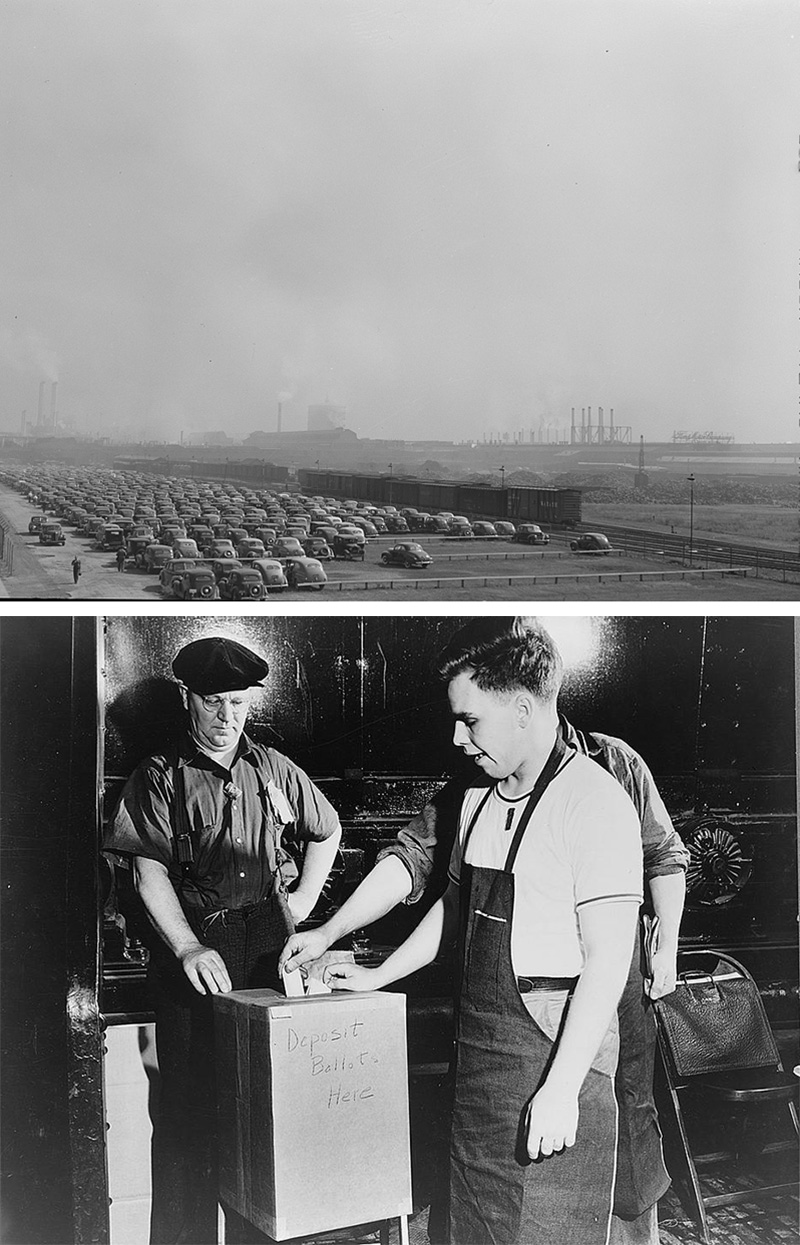
Sinclair gives Ford the book’s last word. But it would be the UAW that got the historical last word over Henry Ford when they successfully unionized Ford Motor Company in 1941. As contemporary reviewers pointed out, Sinclair’s sympathetic view of Ford and this anti-triumphal ending save the novel from serving purely as propaganda. Sinclair genuinely admired Ford; he also thought Ford was corrupted by his fortune. In Sinclair’s autobiography, published in the late 1940s, he gives his own gloss on why the Ford union drive was ultimately successful despite Henry Ford’s intense opposition. Clara, according to Sinclair, said she would leave Henry if he closed his plants, as he’d threatened to do. She had been in the room during the Ford-Sinclair debate, Sinclair writes, and had maybe been convinced by his arguments, even if they had met a hard heart in her husband. “It pleases me to believe that.”
It is an odd coda, for a socialist and a unionist, to chalk up a union’s success not to the workers who fought for it but rather to the industrialist’s wife. Read charitably, it suggests that Sinclair had a deep and abiding faith in the goodness of people who had been corrupted by money. Read slightly less charitably, it suggests a faith in the ability of the individual, the great man, to change history — that one reason Sinclair writes Ford and Gillette so sympathetically is that he feels some kinship with them.
If Ford is so corrupted by his wealth — roughly $1.2 billion, in 1920s dollars, at its peak — we can only imagine what more than $700 billion has done to Elon Musk. For Sinclair, Ford’s billion dollars are shackles, “chains upon his legs, making certain that he would never walk alone, and chains upon his mind, so that he would think no thought of which the billion dollars did not approve.” Faced with challenges to his unbridled pursuit of profit, Ford looks to the examples of strongmen in Italy, Germany, and finds inspiration for his own Ford Service Department. The threat to his money is personified, meantime, in the figure of the supervillain — the Communist, the international Jew — engaged in a “great conspiracy against his billion dollars.”
Gillette, Ford, Sinclair — and, it may be said, Musk — all shared a sort of technofuturism, a belief in a better politics available in an era of industrially provided abundance. Ford and Musk, however, additionally claim a nativist futurism, one that Sinclair argues is motivated by the desire to perpetuate Ford’s own fortune. “He had thought that men could have the machinery and comforts of a new world, while keeping the ideas of the old,” Sinclair writes. When it becomes clear that culture changes with the “new world” — that the world may never have been as Ford, Musk, and their modern ideological brethren believed it was, they express a desire to violently impose it instead. Sinclair writes that Ford’s billion dollars convinced him “that there was a nation-wide, indeed a world-wide conspiracy to take his fortune from him”; Ford’s picture hung on Adolf Hitler’s wall; Musk not only seeks out the approval of Trump, Jair Bolsonaro, Javier Milei, and Narendra Modi, he is often wealthy enough to bend their politics to his desires.
Ford’s opinion on unionization may have been changed at his wife’s urging, as some historians have written, and she may have been influenced by listening to Upton Sinclair, which is less supported by the historical record. But even conceding that train of events, it seems farcical to imagine such a future for Musk, who seems to have no close relationships left in his life. Perhaps the more compelling lesson for us is about what happened between the close of The Flivver King and the winning of the Ford union. A mass movement emerged and did not go away. Thousands of Ford workers engaged in sit-down strikes in Ford’s plants, risking physical safety and their own employment. This is the force that bent capital. This is the force that loosened the grip of Ford’s billion dollars on the world around him.