
A Roosevelt Corollary for the World
T. R. in Panama, by Edward Laning, 1939. [Smithsonian American Art Museum]
There are, no doubt, many Americans who find themselves confused by the Trump administration’s foreign policy in early 2026 — and understandably so. The year started with the January 3 raid on Caracas and the claim that the abduction of Venezuelan President Nicolás Maduro was part of a new “Donroe Doctrine” for the Western Hemisphere. Channeling the 19th and early 20th century “Monroe Doctrine,” this new program, the administration and its supporters suggested, was the logical outgrowth of “America First” thinking, a plan for hemispheric dominance that represented a turn away from the global misadventures of the Bush and Obama years. “I am proudly reasserting,” Trump had promised a month earlier, “President Monroe’s doctrine of sovereignty.” The American people, the President declared, “not foreign nations nor globalist institutions … will always control their own destiny in our hemisphere.” Yet, before the following month was out, Trump had launched a new war on Iran that seemed to conjure up all the ghosts of the more globally oriented “regime change” missions of the previous two decades.
Whatever one might say about the honesty or strategic clarity of the 47th President and his advisors, the idea that that a “Trump Corollary” to the Monroe Doctrine might coexist with efforts to police the world is much less incoherent than it seems, at least in a historical sense. The Doctrine hardly needed to be reasserted at all, as the principles behind it had long since been globalized by Trump’s predecessors — a globalization that ties together Latin America, Iran, and the family of another president who famously attached himself to the Monroe Doctrine: Theodore Roosevelt.
President Theodore Roosevelt, in office from 1901 to 1909, is most responsible for what most Americans likely think of when they consider the Monroe Doctrine. Not that the doctrine’s eponymous president, James Monroe (1817-1825), isn’t part of the story; the through line of the United States’ journey from hemispheric power to global policeman certainly starts with him. Looking anxiously across the Atlantic in 1823, Monroe and his advisors — primarily Secretary of State John Quincy Adams — feared that a European power might take advantage of the collapse of Spanish rule in Central and South America to build a new American empire. Thus, in his December of 1823 annual message to Congress, Monroe announced as U.S. policy that the countries of the Western Hemisphere were “henceforth not to be considered as subjects for future colonization by any European powers.”
Regularly remembered in the U.S. as a brave assertion of anti-colonial principles, Monroe’s message was in reality the product of a relatively weak state cautiously seeking to preserve a future path for its own imperial aggrandizement. At the very least, Adams believed the eventual annexation of Cuba to the United States was, as he wrote in an 1823 letter to the U.S. mission in Spain, “indispensable to the continuance and integrity of the Union.” Others wanted even more. Throughout the 1820s, Speaker of the House Henry Clay imagined a future hemispheric “American system” that would lock the United States in as the dominant manufacturer of the hemisphere, drawing raw materials from the countries to its south to fuel production in North America. Adams and Monroe, however, worried the U.S. was not yet strong enough to assert hegemony over its neighbors. Not only was the country divided over slavery; it also lacked the military power to safely risk war with a strong European state like France, Britain, or Russia. The U.S. was “not yet prepared” for such an enterprise, Adams told his emissaries in Madrid, but if it could but wait and keep the Americas clear of European meddling, the “laws of political … gravitation” might eventually open imperial doors for the United States.
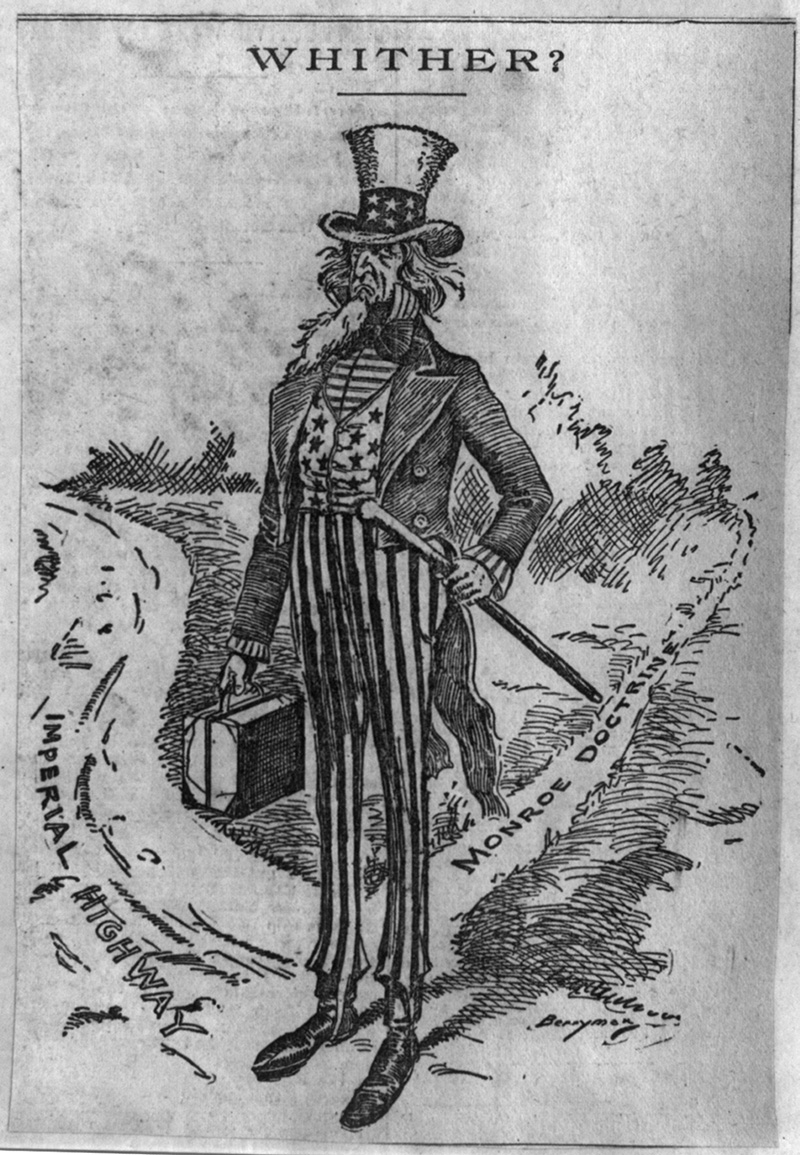
By the time Theodore Roosevelt arrived in the White House in 1901, those imperial doors had swung wide open. The U.S. Civil War had by then settled the slavery issue, clearing the way for the rapid industrialization of the U.S. through the final decades of the 19th century. The American victory in the Spanish American War of 1898 subsequently announced the arrival of the United States as world power, quite capable of dominating the Western Hemisphere much as Clay had imagined 80 years earlier. American merchants, money, and goods flooded south as the United States increasingly became Latin America’s dominant trading partner — a generally unequal relationship that saw lower priced commodities heading north in return for more expensive manufactured goods for Latin American consumers.
However, this arrangement, while beneficial to the United States and Latin American elites, was also inherently unstable. Unbalanced trade helped foster poverty and political volatility in Latin American trading partners, poverty and volatility, which in turn threatened U.S. business interests and potentially opened the door to European intervention in the guise of debt collection. Seeking in 1904 to forestall just such an intervention in the Dominican Republic — where a series of short-lived governments had struggled to pay the state’s obligations to foreign creditors — Roosevelt decided the solution lay in unilateral American intervention instead. To justify the move to the American public (and to send a strong message to the other powers across the Atlantic, especially Germany), he turned to the Monroe Doctrine.
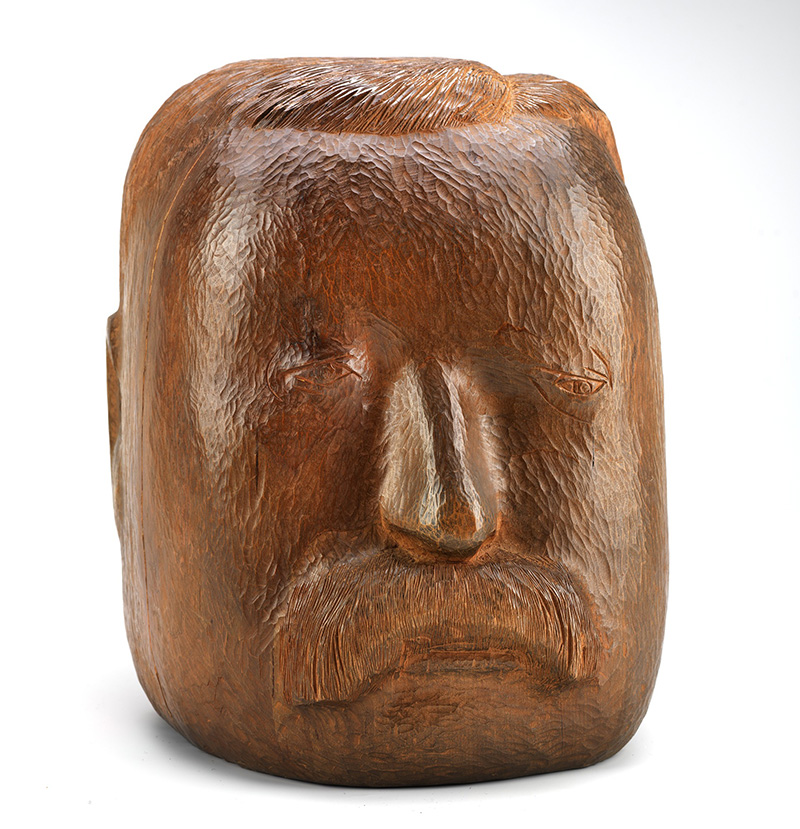
In his December 1904 annual message to Congress, Roosevelt announced a new more expansive definition of the doctrine. His “corollary,” as it came to be known, transformed Monroe’s prohibition for Europeans into a prescription for the United States; no longer would the United States just forbid European intervention, it would use its power to order the hemisphere as it saw fit. The United States, Roosevelt told Congress, as the most advanced “civilized nation” in the Western Hemisphere, had a right to “exercise … an international police power” in the Americas in “flagrant cases of … wrongdoing or impotence.” By flagrant cases of wrongdoing, he meant situations where political instability threatened political order and the flow of raw materials and loan payments to the U.S. and Europe. “Our interests and those of our southern neighbors are in reality identical,” Roosevelt suggested, “they have great natural riches, and if within their borders the reign of law and justice obtains, prosperity is sure to come to them.” But if “it became evident that their inability or unwillingness to do justice at home and abroad had violated the rights of the United States or had invited foreign aggression,” then the U.S. had a right to intervene.
The right to political “independence,” Roosevelt argued, could “not be separated from the responsibility of making good use of it.” The Roosevelt Corollary would subsequently justify dozens of interventions and occupations by Roosevelt and his successors, bringing much of the Caribbean and Central America under direct or indirect U.S. control. By 1934, the U.S. had intervened with either troops, naval forces, or customs officials in not only the Dominican Republic, but also Cuba, Colombia (creating a U.S. protectorate in Panama), Honduras, Haiti, Nicaragua, and Mexico.
The Roosevelt Corollary is popularly seen as losing its relevance over the course of the 1930s and 1940s, as the U.S. turned away from empire and, after World War II, toward building what is sometimes called a “liberal world order.” Ostensibly structured around institutions like the United Nations and principles like “self-determination,” that order appeared to contrast sharply with the hierarchical vision of the Roosevelt Corollary. Instead of “civilized” nations asserting a police power over weaker countries, the community of nations would now work together through egalitarian institutions like the United Nations General Assembly, building a world order structured and policed by collective agreement and treaty. Even with somewhat more sordid concessions to realities of power — like the great power-dominated UN Security Council — this liberal order seemed a major reform. Some historians have likened it to a vision of a “New Deal for the world,” a program for a globalized version of the reform-oriented “New Deal” President Franklin D. Roosevelt (1933-1945) had brought to the United States in the 1930s.
Yet, to whatever degree the New Deal can be said to have globalized after World War II, it was more the ideas of the Roosevelt Corollary that took on global dimensions in the second half of the 20th century. In 1945, the U.S. found itself in a position vis-à-vis the entire world that was not dissimilar to its relationship with Latin America roughly five decades earlier. It was now the dominant economy of the world, drawing commodities from across the globe to fuel domestic production and consumption. Extending that concern was the plight of America’s Western European allies — desperately in need of access to affordable raw material markets to rebuild their war-torn economies and become bastions of resistance to communism amid a burgeoning Cold War between the U.S. and the Soviet Union. As Senator Henry Cabot Lodge Jr. put it in 1949, “we need … these countries to be strong, and they cannot be strong without their colonies.”
The problem was that most countries across the Global South no longer wanted to be dominated by Europeans or the U.S., whether that domination came either in the form of formal colonization or more informal arrangements of control. Alejandro Carrillo, a Mexican academic, summed up the sentiment of the U.S.’ southern neighbors in this way in 1945: “If you believe Latin Americans wish to continue producing only raw materials for U.S. manufacturing … you are certainly mistaken.” Restive populations in Western Europe’s Asian and African empires felt much the same way. In the decades after World War II dozens of nationalist parties and anti-colonial movements from — to name just a few — India, Pakistan, and Indonesia, to places like Kenya, Tanzania, and Morocco in Africa, and across the Caribbean and in Central America, were gaining or seizing power in the name of altering the global political and economic status quo.
American policymakers were not uniformly hostile to this wave of decolonization and nationalist economic self-assertion. They made it clear they could work with governments that ensured, in Teddy Roosevelt’s framing, that “within their borders the reign of law and justice obtains.” But Washington’s conception of law and justice was often at odds with the vision motivating anti-colonial and nationalist movements. Many of those movements were engaged in what Roosevelt would have called “flagrant cases of … wrongdoing or impotence,” namely the seizure of foreign owned property and natural resources. In the 1950s, U.S. troops and secret agents fanned out across the world, ordered to every continent to openly fight or secretly help overthrow those regimes threatening “freedom” — by which they often meant Western European or American access to natural resources and property.
What the U.S. had established was less the product of Franklin Roosevelt and more derivative of Teddy: a “Roosevelt Corollary for the world” rather than a global New Deal. This was not just because Washington was, in effect, asserting the elder Roosevelt’s “international police power” on a global scale, but also because it was another Roosevelt who helped orchestrate an early assertion of that police power in Iran. Mohammad Mossadegh had been elected prime minister in 1952 on a promise of restoring the sovereignty of the Iranian people over their natural resources. Of particular concern was the oil controlled by the British Anglo-Iranian oil company, which extracted much of Iran’s oil wealth and only sent a very small percentage to the Iranian government in return. An anti-communist, Mossadegh nevertheless set off alarm bells in Washington by spearheading legislation to nationalize Iran’s oil fields in 1953. In response, the CIA — led in Tehran by Teddy Roosevelt’s grandson, Kermit Roosevelt Jr. — in cooperation with Britain’s MI6, orchestrated a coup that overthrew Mossadegh and concentrated power in the hands of Shah Mohammad Reza Pahlavi. Thanking Roosevelt for his work, the Shah told the American spy that he owed his throne “to God, my people, my army … and to you.”
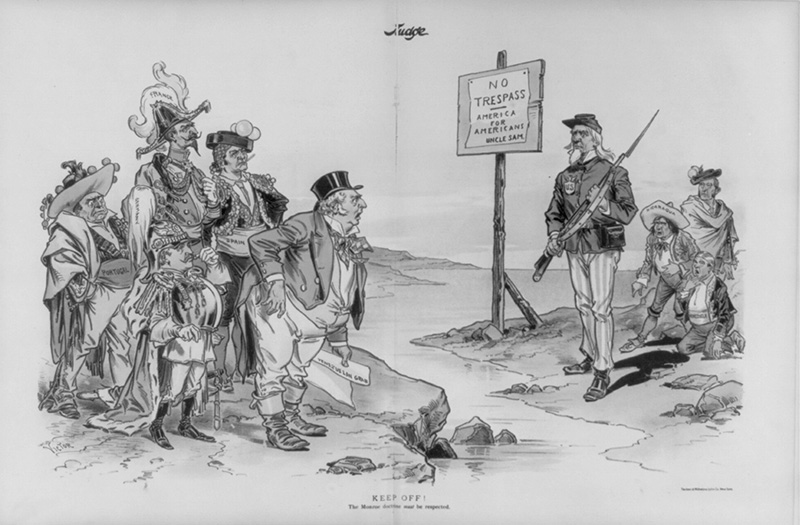
In addition to spawning the decades of anti-American sentiment that later helped fuel the Iranian Revolution in 1979, the coup in Iran was also a beginning to decades of American efforts to overthrow governments that conflicted with perceived U.S. interests. It continued just a few years later when CIA operatives initiated a successful coup against the democratically elected President Jacobo Árbenz in Guatemala, which was followed by the failed “Bay of Pigs” effort to remove the Castro regime in Cuba in 1960, a 1963 coup in South Vietnam, and U.S.-backed military coups in Brazil in 1964 and Chile in 1973.
Coups were not the only strategy for enforcing the global corollary. Another common method was providing arms and money to one side or another in civil wars in countries such as Greece, Congo, Angola, Nicaragua, and El Salvador. In the later years of the Cold War and after, Washington also turned to outright invasions like in Grenada in 1983, Panama in 1989, Iraq in 1991 and 2003, and Afghanistan in 2001. For officials in Washington, DC, from 1945 to the present, it seemed, no corner of the Earth was exempt from America’s “international police power.” Though Theodore’s Corollary was not evoked explicitly by postwar policymakers, these efforts to police the liberal world order all were justified in fundamentally similar terms: the U.S. had a responsibility to protect the “civilized”—or as it often called after 1945, “free” — world from those that Americans believed threatened it. The exact definition of that world may have changed with time, but the assumption that the U.S. was its protector remained consistent.
The Monroe Doctrine, it turns out, never went away — it just moved further afield. It was hardly in need of resurrection. In fact, if Trump’s foreign policy represents a change in any form, it’s not so much in bringing back the logic of the Monroe Doctrine but in leaving it behind, at least in part. While U.S. presidents from Monroe to Biden have generally found it necessary to insist that American primacy served not just the United States but the “civilized world” or the “liberal world order” and — through it — humanity writ large, Trump seems to have no such compunction. His Monroe Doctrine retains the insistence on American supremacy without the progressive packaging. What practical difference this will make going forward remains a question.