
The Hard Work of Reckoning with Local History
This piece is part of an ongoing series about the work of public historians at a time when funding is growing scarce, and opportunities abound for bad history to circulate. The series invites contributors to reflect on critical questions in the public history field, such as: How do you make history visible and show people how to see it as part of the world they live in? What strategies have proven successful, and what aspects of “industry practice” have been less helpful? How do you challenge calcified ideas about history that are off-kilter or incomplete? Are you a public history practitioner with insights to share? Consider sending us a pitch.
The city of Sherman lies in the center of north Texas, a little south of the Red River and the border with Oklahoma. The area isn’t popularly associated with the history of racial violence in the same way as the Deep South; public memory of historical violence looks more like celebrations of figures such as Doc Holliday than lynching memorials. But racial violence did shape the region, from the 1893 lynching of Henry Smith in Paris to the 1998 murder of James Byrd Jr. in Jasper. Some three hours north, the 1921 massacre of more than 300 residents of the Greenwood neighborhood in Tulsa, Oklahoma, has rightly become infamous as one of the worst instances of racial violence in U.S. history. Less well remembered is the fact that nine years later, a race riot in Sherman drew national and international attention and saw the city placed under martial law for more than a week. A mob set the county courthouse on fire to kill Black farmworker George Hughes, who was accused of assaulting a white woman. Onlookers gathered to watch from the shadow of the first Confederate memorial in Texas, erected in 1896 on the courthouse lawn. Following the lynching, the mob destroyed much of the city’s prosperous African American business district.
Sherman has struggled to reckon honestly with its past. Within days of the Hughes murder, city officials claimed that outside agitators were responsible for the violence, arguing that the city itself had been the real victim. To this day, there are those in the area who refuse to call the murder of Hughes a lynching, clinging to the tendentious argument that he was killed by fire rather than by hanging. Despite recent efforts to document lynchings across Texas, too many people are made too uncomfortable by the idea that the violent legacies of American slavery hang over their own personal histories. We need look no further than the efforts to restrict what students in Texas public schools can learn about this history to know what power such feelings still hold.
Austin College, a small liberal arts school where we both teach U.S. history, has been in Sherman since 1876. While individual faculty at the college, including our predecessors in the History department, have worked to bring greater attention to this history, there had until recently been little institutional or community effort to bring the riot of 1930 back into public memory. Nor had the violence in Sherman received significant academic attention beyond a handful of scholars. Neither of us had heard of George Hughes before moving to Texas in the 2010s, when community members were beginning to advocate for a historical marker about his murder. But even then, many lifelong Sherman residents remained disconnected from, uncomfortable with, or ignorant of the events of 1930. Many of those who did know about it were reluctant to trust or share this part of local history with representatives of the college, especially in an area where the “liberal” of “liberal arts college” is often seen as a political leaning. Although more than 90% of our student body hail from Texas, the vast majority — including students from the immediate area — had never encountered this history in any form. Any attempt to reclaim historical memory had to start there.
We began a research project in 2020 to ask questions left unanswered by Sherman’s refusal to remember 1930: How can we understand the impact of the lynching and riot on Sherman’s Black community? How do we contextualize Sherman’s local history within the broader history of racial terror lynchings? And how can we connect people today to a history that has been largely forgotten and frequently suppressed? These questions became the foundation for our work with the Council of Independent Colleges’ Legacies of American Slavery program, a three-year grant that funded seven private colleges in five different states to explore different legacies of slavery in their communities. That grant funded both independent research and a range of class activities that emphasized the concept of place-based education, highlighting the prevalence and relevance of history in our students’ immediate physical spaces.
The Austin College students we worked with began by sifting through city directories, census records, and tax documents to build a core database that included all available data on city residents, from residential address to employment to family relationships. They examined migratory patterns, looking at where residents moved from and to. This painstaking process saw the students cross-reference these sources to confirm accuracy, check for inconsistencies, gaps, and mistakes in those records, and, at times, navigate exclusionary local record gatekeeping practices, including the county courthouse’s apparent reluctance to share tax records.
Students then used Google Maps to create a free resource making these data easily accessible to the public. The digital map shows the names, addresses, employers, property listings, and family members of Sherman’s Black population in 1928 and in 1935. The students found that physician Daniel W. Porter, for example, lived in the heart of the Black business district in 1928. He left Sherman following 1930 to live in Smith, Texas. Map users can easily find the location of Porter’s home and place of work on a modern map of Sherman, or find Porter in an alphabetical listing of specific individuals. This biographical information can serve as the starting point for research questions about the lives of Porter, his family members, and his community. Did he live with family members and/or other people? Did he own his home? Who else worked at his medical office? Who were his neighbors? What cultural institutions were a part of his life?
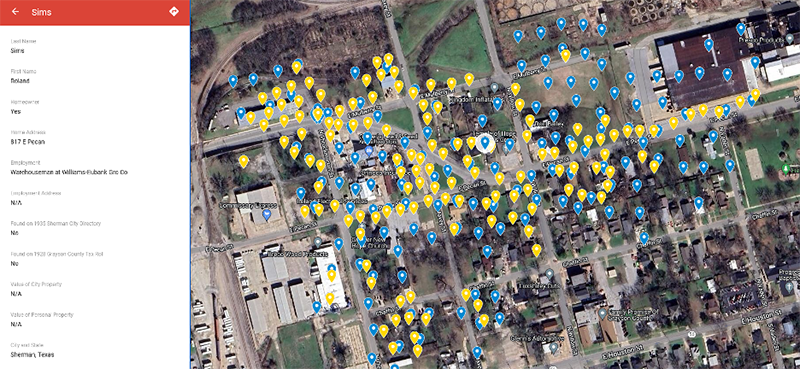
Our team of faculty and students uncovered some surprises about the migration of Sherman’s Black homeowners and residents. Previous studies had endorsed the widely held notion that the 1930 lynching and riot led to an exodus from the city and the virtual end of the Black community in Sherman. Our research also confirmed that the riot had a significant demographic impact. Sixty-one percent of the pre-1930 Black residents of Sherman left, primarily relocating to larger urban areas across Texas. At the same time, the city saw an influx of Black residents, mainly from surrounding rural areas but also from other cities in Texas. By 1935, the Black population of Sherman was actually slightly larger than it had been pre-riot, even if it was composed of many new families. This realization opened new avenues of inquiry to explore. In a 2024 class taught by one of our anthropology colleagues, students used our map to guide further ethnographic research, including oral history interviews with current residents as well as archival newspaper research. Students will continue exploring why some Black families remained and why other newcomers moved to Sherman in a new class about local and public history next fall. Meanwhile, residents have begun to use the database to learn more about the histories of their family members and homes.
As our students were completing the map, a new group called the Sherman Historical Conservation Coalition was working with Sherman’s city council to preserve the former home of a Black lawyer whose business was burned in 1930. The house belonged to William J. Durham, who would later go on to be one of the state’s preeminent civil rights attorneys, helping to establish key legal precents around voting and education rights. Although Durham’s house proved too structurally unsound to salvage, many saw it as a sign of progress that the city considered it at all.
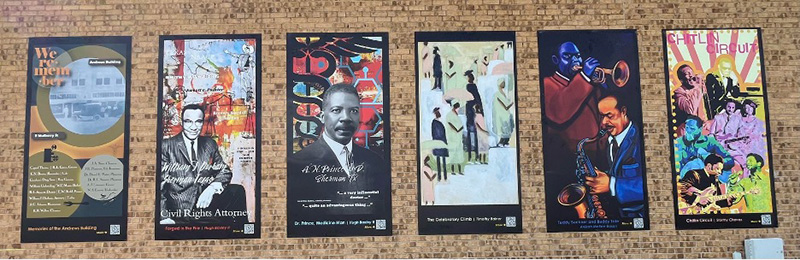
Around the same time, the Sherman Cultural District won a grant from the Texas Commission on the Arts to commission a six-part Sherman Black History Mural Series created by local artists. Our students’ research into local history informed the visual designs of the murals, which were mounted on the outside wall of the Sherman Public Library in August 2024 alongside QR codes providing more context. The murals moved beyond a focus on the violence of 1930 to celebrate the history of Sherman’s Black community more broadly.
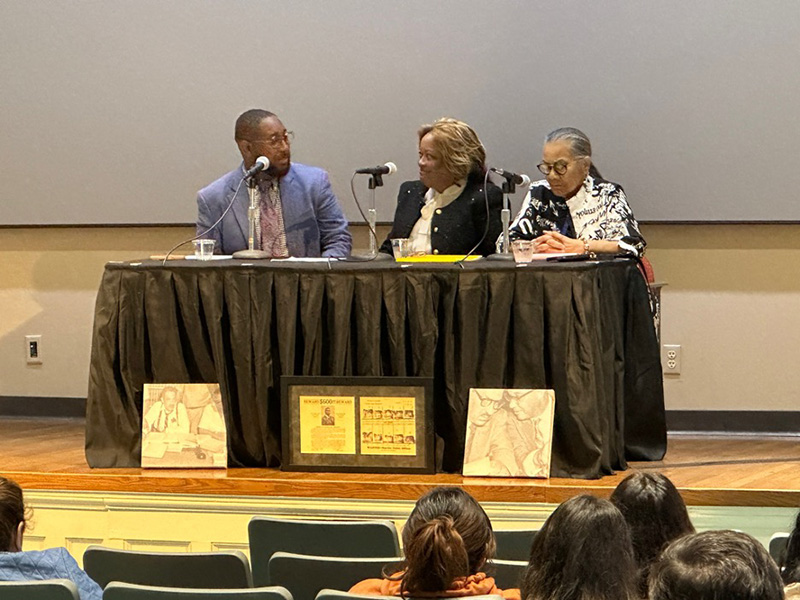
Local history has been more visible in other places as well. Two descendants of William J. Durham, Judge Maryellen Hicks and Councilwoman Kathleen Hicks of Fort Worth, took part in a public panel at Austin College in April 2023. Community partners, inspired by the Ghanaian concept of Sankofa, loosely translated to mean looking back in order to move forward, developed a walking tour of Black history in the city that has drawn approximately 200 attendees over its several-year existence.
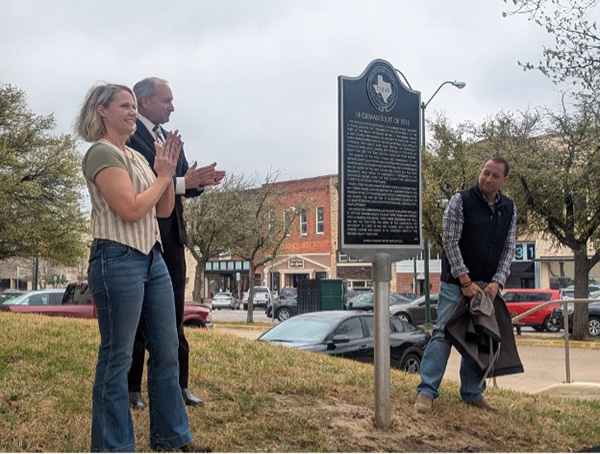
The shift toward community healing was arguably most evident in the campaign for the installation of an official state marker outside the county courthouse about the George Hughes lynching. This was the community-driven struggle that initially drew us to the subject. But what we initially believed would be a fairly straightforward process in 2021 quickly turned into a years-long and bruising foray into local politics. This political fight had significant ramifications. Initial resistance to the marker was so strident that it made national news, most prominently in the Washington Post. At least in part due to the effort for the marker, the county historical society has since been almost totally reconstituted, and the majority of the County Commissioner’s Court has either retired or lost reelection. The kinds of suspicions that clouded public debate were made evident on one occasion when a faculty member and student were followed back to campus by two individuals after a walking tour of local Black history sites. The community members pointedly asked what campus members had been doing and what “kind” of history they had been learning.
While it was the local resistance that received national coverage, many locals have been actively committed to illuminating the more hidden parts of Sherman’s past The local NAACP chapter supported student scholarship opportunities and organized meetings for the murals and walking tour. Local churches and banks offered spaces to meet in town halls about local Black history and marker planning committees. Our students and other members of the Austin College community shared their academic expertise in a wide variety of venues and volunteered their time to support public gatherings. Navigating local mechanisms of government — as well as overcoming suspicions attached to higher education more broadly — was difficult as Texas transplants. By decentering ourselves and instead focusing on coordinating and connecting various stakeholders, while providing material and scholarly support, we ensured that a broad coalition of community members were rightfully seen as the leaders of the effort.
In March 2025, thanks in large part to the efforts of community members Melissa Cole and Kurt Cichowski, we were able to finally hold a marker unveiling and dedication ceremony, where our students shared their map with the descendants of those most affected by the riot. One descendant especially valued the chance to learn the names of more Black Sherman property and business owners. She continues her mother’s legacy of uncovering and preserving the stories of those affected by the lynching of George Hughes and the 1930 riot, as well as honoring the stories of her great-grandparents in Sherman during the 1930s. Austin College students, including both those who had worked on the research and those who had not, reflected on how the dedication ceremony was a poignant opportunity to connect with the local histories of their communities in ways they had not been able to do so before. Inspired by the experience, students who were involved with the project have employed the skills and experiences developed in their work with the grant in their own honors projects and/or in moving on to graduate work in public history, museum studies, and law.
Though much effort and struggle went into erecting the marker, the project isn’t finished. The community’s efforts opened a space for more remembrance projects of this kind. Much remains to be done when it comes to bridging the disparity between local history and public memory. The new art installation faced backlash from those claiming that a focus on Black history was unnecessary and divisive. At the same time, it is undeniable that these legacies of slavery — long forgotten and actively denied — are finally seeing the light of day thanks to the tireless work of Austin College students and local community members. A William J. Durham marker application will be submitted soon, having begun life as part of our student research. The vibrancy and success of the historic Black business district is once again becoming part of Sherman’s story. And the connections and networks we have been able to forge across the region as part of that work mean that it isn’t only on the Austin College campus or in Sherman where we have seen more attempts to reckon honestly with local histories.
Read the first essay in this series from David Trowbridge, creator of Clio.