
Deploying Federal Troops to U.S. Cities Is a Second Amendment Issue
The Boston Massacre, after Henry Pelham, printed by Paul Revere Jr., 1770. [The Metropolitan Museum of Art]
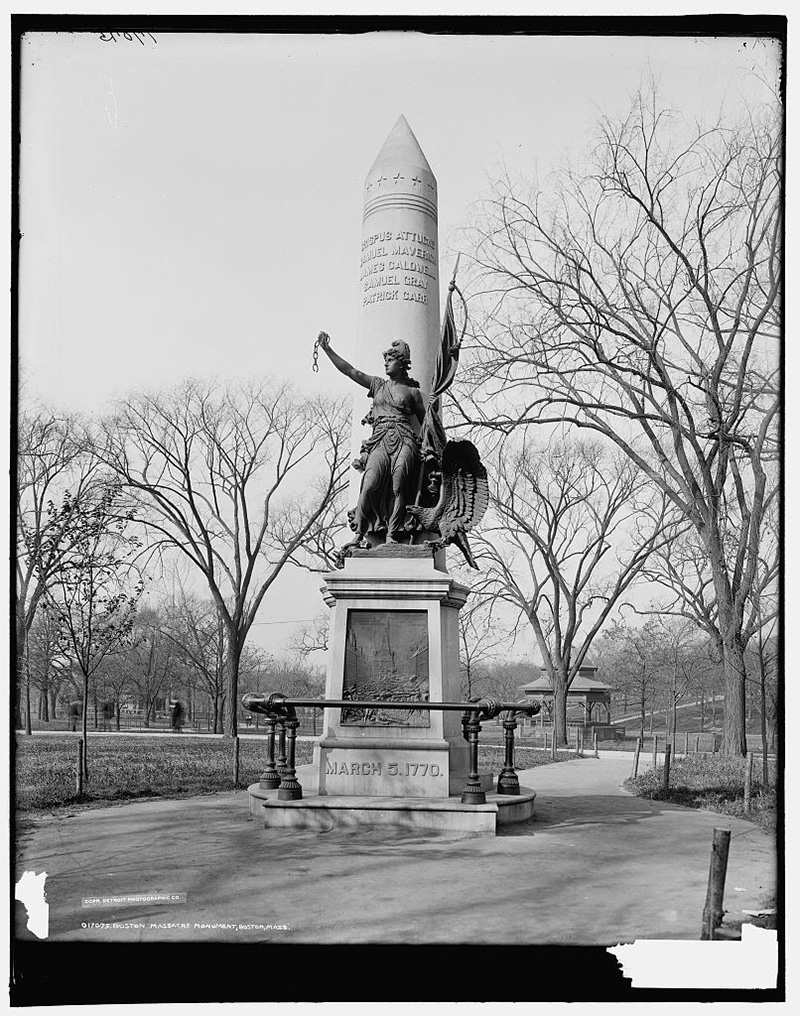
On March 5, 1770, a boy began arguing with a British soldier stationed outside of Boston’s Customs House. Soon other Bostonians joined in, as did several more soldiers. Eventually a few hundred Bostonians were facing off against nine soldiers, even pelting them with snowballs. Then the soldiers opened fire into the crowd, killing five people. Patriots all along the East Coast began calling it the Boston Massacre. It became one more item in what Thomas Jefferson would later call the “long train of abuses” that led the colonists to declare independence.
Today’s self-proclaimed Second Amendment supporters think they have a solution for such situations. The problem, they say, was that the soldiers had guns and the protesters did not. Without commenting on the desirability of an armed standoff in a crowded city, individual citizens taking on the military was not what the founding generation’s leading men wanted. That might be today’s Second Amendment solution, but when the amendment was written, it was the last thing on anyone’s mind.
The Second Amendment was meant to prevent events like the Boston Massacre — just, not like that. Not by flooding cities with guns, but by avoiding those situations in the first place. The amendment was meant to prevent the government from turning its military into an occupying force, as the British were doing when they began stationing troops in Boston. It is also what our current president is trying to do when he sends federal troops into Los Angeles. Or Portland. Or Chicago. Or, eventually, New York and Boston.
The courts have been treating those deployments as Tenth Amendment issues, or as potential violations of the 1878 Posse Comitatus Act, but back when the Bill of Rights was written, the domestic deployment of federal troops was the Second Amendment issue. And if the courts understood that, we would be in much less of a mess right now. In 2025, the amendment might be about privately owned guns, but when the Bill of Rights was ratified in 1791, it was about the military — specifically, the threat that a nation’s military could pose to its own people, as it had in Boston during the 1770s, when the British government began stationing troops there.
In the massacre’s aftermath, the British reduced the number of soldiers in Boston. After the Boston Tea Party in 1773, though, the British changed course again, stationing thousands of soldiers in the city and the surrounding region. This did not please local residents. In 1774, the Massachusetts Provincial Congress complained that “While the British ministry are suffered with so high a hand to tyrannize over America, no part of it, we presume, can be negligent in guarding against the ravages threatened by the standing army now in Boston.”
This would not be the last time that the colonists complained about England’s “standing army.” The term itself has fallen out of use, but the idea is quite simple: for the most part, a standing army is what we would today call, “an army.” More specifically, it is an army that exists whether or not the nation is at war, and whose soldiers serve full time for some period of years. Usually, those soldiers are paid for their service, as was the case for the British soldiers stationed in Boston, though the term can also be used for armies whose soldiers are forced into service. The U.S. Army today, for instance, is a standing army.
Employing full-time paid soldiers during peacetime was controversial during the 18th century, in ways that only make sense if you keep a few distinctions in mind. First, up until this point, the colonies had relied only on militias, in which citizens participated part-time because they were required to, without compensation. Second, England had a tradition of looking askance at peacetime armies, even if that tradition had faded by the 1770s. When England wrote its own Bill of Rights in 1689, they made sure to declare that kings could not keep standing armies during peacetime without Parliament’s consent. Third, while today the distinction between an internal police force and an external army is clear, that was not the case during the 18th century. A peacetime standing army was precisely what Boston faced in the 1770s: the British government was using its army to police its own citizens in one of its colonies. Bostonians’ own military had become an occupying force.
For the colonists, this was a very real threat, but it was also a violation of what they perceived as their ancestral rights. The Continental Congress’ 1774 Declaration and Resolves, one of the first statements that the united colonies addressed to England, pointed out that colonists were “entitled to all the rights, liberties, and immunities of free and natural-born subjects, within the realm of England.” Given those rights, “the keeping a standing army in these colonies, in times of peace, without the consent of the legislature of that colony, in which such army is kept, is against law.”
The colonists’ complaints mattered little to the government back in London, which at the time was convinced it could bring the colonies back into line. But as the sense of unity between the colonies grew, the soldiers’ presence in Boston became an affront to patriots in other colonies as well.
In April 1775, the British government did what its hardliners had been calling for. The troops in Boston were sent inland, in the hopes that striking a major blow against the pesky colonists would silence them. That foray did not turn out as planned: the Redcoats lost to the Minutemen at the Battle of Concord Bridge and had to retreat to Boston. The two sides would remain at war for the next six years.
The British troops’ presence in Boston during peacetime still stung when states began writing their own constitutions in 1776. Virginia’s Bill of Rights declared that a well-regulated militia was the proper and natural defense of a free state, and that standing armies were “dangerous to liberty.” Other states followed suit, often copying Virginia’s language. The Declaration of Independence, in its long list of accusations, called out George III for having “kept among us, in times of peace, Standing Armies, without the Consent of our legislatures.” The colonists had seen what a peacetime standing army was capable of, and they did not like it. But now that war had begun, the Americans accepted the necessity of raising and training their own army to fight the British.
The men who fought in the American Revolution were, overwhelmingly, professional, full-time soldiers. This was always true of the British troops, and beginning in June of 1775, it was true of the Americans too. It was also true of the French troops who fought alongside the Americans, and of the Hessian soldiers who fought for the British. State militias fought in the war, but their performance did not make anyone think that they would have been able to defeat England on their own. As Alexander Hamilton wrote in Federalist 25 in 1787, “The steady operations of war against a regular and disciplined army can only be successfully conducted by a force of the same kind,” and attempting to defeat the British with only militias “had like to have lost us our independence.”
In the years immediately following independence, neither the state militias’ shortcomings on the battlefield during the Revolution, nor the Continental Army’s successes, made Americans any less wary of peacetime standing armies. Leaders of the founding generation still believed that because a professional soldier relied on his job for his livelihood, his allegiance was to his commander, not his nation. (The current commander-in-chief recently endorsed this view, albeit unknowingly, when he told an audience of military leaders that “if you don’t like what I’m saying, you can leave the room. Of course, there goes your rank, there goes your future.”) A citizen-soldier who served part-time in their local militia unit, though, would remain loyal to his nation and would still be a part of his community. As Samuel Adams put it in a 1776 letter to James Warren,
A standing Army, however necessary it may be at some times, is always dangerous to the Liberties of the People. Soldiers are apt to consider themselves as a Body distinct from the rest of the Citizens … They soon become attachd to their officers and disposd to yield implicit Obedience to their Commands.
A citizen-soldier who served part-time in his local militia unit, on the other hand, would be more likely to remain true to his own local loyalties. As Adams wrote, the militia was “composd of free Citizens. There is therefore no Danger of their making use of their Power to the destruction of their own Rights, or suffering others to invade them.”
Jefferson, too, was insistent that the Constitution should include “a bill of rights providing clearly and without the aid of sophisms … protection against standing armies,” as he wrote in a 1787 letter to James Madison. Having seen in the leadup to the war the problems that the British army caused when occupying Boston, the founders were eager to not recreate the same situations in the new republic.
Samuel Adams and Thomas Jefferson did not write the Second Amendment; James Madison and the rest of the United States Congress did. But when Congress declared that a well-regulated militia was necessary for the security of a free state, it was endorsing the same tradition of thought that had led Adams and Jefferson to oppose standing armies, and had led Virginia to declare standing armies dangerous to liberty. If the new republic wanted to be free, its security should be entrusted to the militias for as long as it could be, because a society that relied on a professional army during peacetime would never be truly free. There was always the potential that such an army could again become an occupying force. If soldiers were loyal to the men that commanded them, as the founding generation believed professional soldiers to be, there was nothing to stop those commanders from deploying their troops however they saw fit; and if there was no militia, there would be no existing counterbalance to those troops. George Washington’s leadership of the Continental Army had kept the United States from that fate, but the nation could not count on future generals and presidents doing the same. The potential that a power-hungry leader could set the military against the very population it was meant to protect would always loom. The Second Amendment is part of the Bill of Rights because the men who wrote it wanted to prevent that from happening.
The National Rifle Association is not a Second Amendment organization. It’s a gun rights organization, and a successful one at that. The most tangible impacts of its success have been the loosening of gun laws in most states and the growing arsenals in American homes. But its most thorough success has been getting nearly everyone, including the U.S. Supreme Court, to see the Second Amendment as it does: as an amendment about guns. Whenever politicians talk about balancing public safety with “our Second Amendment rights,” they are already accepting the NRA’s framing. In this version of the Second Amendment, the founders’ vision of a society that refused to use its military to subdue its own population is reduced to rag-tag groups of overly armed Americans reenacting Red Dawn. The institutional safeguards against military overreach are gone.
This guns-only vision of the Second Amendment makes sense for a gun rights organization; for jurists, it does not. Even jurists who support gun rights have to rule on a variety of issues, including the executive’s ability to deploy the military domestically. Yet a guns-only vision has been the approach that the courts have taken. When the Supreme Court took up District of Columbia v. Heller in 2008, it had to decide whether the Second Amendment guaranteed an individual right to bear arms. It was a difficult question, because it was not one that the framers would have asked. Ruling that the rights protected by the amendment included an individual right to bear arms would have made some sense.
That was not what the court did, though. In the majority opinion, Justice Antonin Scalia claimed that protecting an individual right to bear arms was the Second Amendment’s entire purpose. The amendment, he wrote, protected “only individuals’ liberty to keep and carry arms.” Emphasis mine, but when a Supreme Court justice makes such an egregiously inaccurate claim, it deserves to be emphasized.
Scalia’s assertion was not only a misreading of the amendment’s history that obscured the issues which were most important when the amendment was written. The ruling also ignored those aspects of the amendment that are again relevant today.
“Undoubtedly,” Scalia wrote in his opinion, “some think that the Second Amendment is outmoded in a society where our standing army is the pride of our Nation, where well-trained police forces provide personal security, and where gun violence is a serious problem.” The irony — behind the uber-originalist’s misunderstanding of the amendment’s original meaning — is that in 2008, the amendment was far more outmoded than it is now. In 2008, masked ICE agents were not roving the streets and terrorizing citizens. Federal troops had not been deployed to Los Angeles. The president was not talking about sending more troops into Chicago and other cities.
In Second Amendment terms, this president is doing everything he can to build a standing army that he can use domestically against his own population. If the Second Amendment’s self-proclaimed supporters both inside and outside the courts appreciated the significance of these policies, and how contrary they are to the amendment’s original goals, the nation might be in a better place right now. In deploying federal police and military units as an occupying force, the president is doing precisely what the amendment was meant to prevent.