How White Supremacists Responded to the Great Strike of 1877
The railroads of the 1870s were the most powerful economic sector in the United States. They were also the least regulated, and created chaotic cyclical fluctuations in employment and wages. Much like the Slave Power of the previous generation, the industrial magnates avoided accountability for the misery they inflicted upon the country through the purchase of politicians. Rutherford B. Hayes won his presidential election because of his allegiance to the rail line “robber barons.” Thomas Alexander Scott, president of the Pennsylvania Railroad, rallied the support of Southern congressmen for Hayes’ cause, and Hayes was notified of his win en route to Washington while riding in Tom Scott’s luxurious private train car.
The robber barons speculated on new lines, bet against others, and otherwise treated the economic livelihood of millions like a casino game. They were allowed to do so through a system of political power based on a regional hierarchy. New England, New York, and Washington held the nexus of industrial might, with every industrialized city serving as a franchise opportunity for the ultra-wealthy.
At the time, St. Louis was a city to bet on. As the historian James Neal Primm notes in The Lion of the Valley, while the boardrooms were in New York, the “general offices of this railroad empire were in St. Louis.” Jay Gould, one of the most notoriously ruthless robber barons, was interested in St. Louis as the gateway to the undeveloped West. St. Louis, the doorman to the extensive cache offered by the American West, thus became geopolitically important. For Gould, the city was a means to control two of his major Western railroads — the Missouri Pacific and the Denver & Rio Grande. “There was not an ounce of civic virtue in him,” Primm writes. “He cared as little for St. Louis as he did for New York. His goals were money and power, but in their pursuit he filled the warehouses and made the rails hum.”
But money is not value. What made the railways hum, said Marx, were the workers who hammered stakes into the tracks, and shoveled coal into the engines, and greased the machinations of iron and fire that circulated capital. Without labor, everything came screeching to a halt.
Rail yard strikes had broken out across the U.S. during the summer of 1877, as if lightning had struck the tracks, shooting westward current through the Baltimore rail yards, to the fields of iron tracks in Philadelphia, to the hub of Chicago, and now to the last outpost of civilization before California: St. Louis, a city choked with railways spanning the Mississippi. Bridges made St. Louis an artery particularly vulnerable to interruptions in American capital flows.
St. Louis railway workers demanded the restoration of a wage scale that had been ripped away from them in the recent boom-and-bust cycle of bankruptcies. A vote was taken, and the workers said yes — strike.
The iron heart of St. Louis stopped during the Great Strike in 1877. Capital was paralyzed, and panic began to set in. “The railroad employees met at East St. Louis tonight and have resolved to stop all freight trains and switching engines after midnight,” wrote J. H. Wilson, a railroad manager, to the secretary of the interior in Washington, DC. “No violence yet. Are there any troops at arsenal here [?] the situation is alarming.”
From interviews that appeared in newspapers of the time, it’s clear that local opinion backed the strike. It had been provoked by corporate greed. Wages were too low for survival. Everyone in St. Louis lived among the crowds of unemployed, and local leadership knew the crisis could boil over — Henry Overstolz, mayor of St. Louis City, requested that the rail companies meet with the strikers as soon as possible. Mayor Bowman of East St. Louis volunteered to act as a liaison with railroad owners for negotiations. The companies refused.
The strike leaders of 1877 warned that corporations had taken control of the government and were using money and power to legally enslave everyone. “Why should we allow ourselves to be trodden upon by a few monopolists,” Peter Lofgreen asked the crowd, “who have the reins of government in their hands, are using the organized assassins to crush us?”
Others argued that the military, which had been built to repel invasions of foreign powers, was now being used to oppress and slaughter innocent men, women, and children. Another speaker pointed to the grand buildings of St. Louis, which were owned by the rich, built by the poor. “Why this state of things?” a speaker asked. “Because it’s so, according to the law. Well, if that’s law, then d—n the law. [Prolonged cheers.] If that is the rule that governs society, then the sooner it is broken the better.”
As The New York Sun noted, Black participation in the St. Louis strike served as “a novel feature of the times.” Roustabout labor was backbreaking — it involved long hours hauling cargo on and off the steamships, and was largely performed by African-Americans, many of whom where formerly enslaved. A Black worker took the stage at the rally asked the St. Louis crowd, “Will you stand with us regardless of color?”
“We will!” the crowd shouted back.
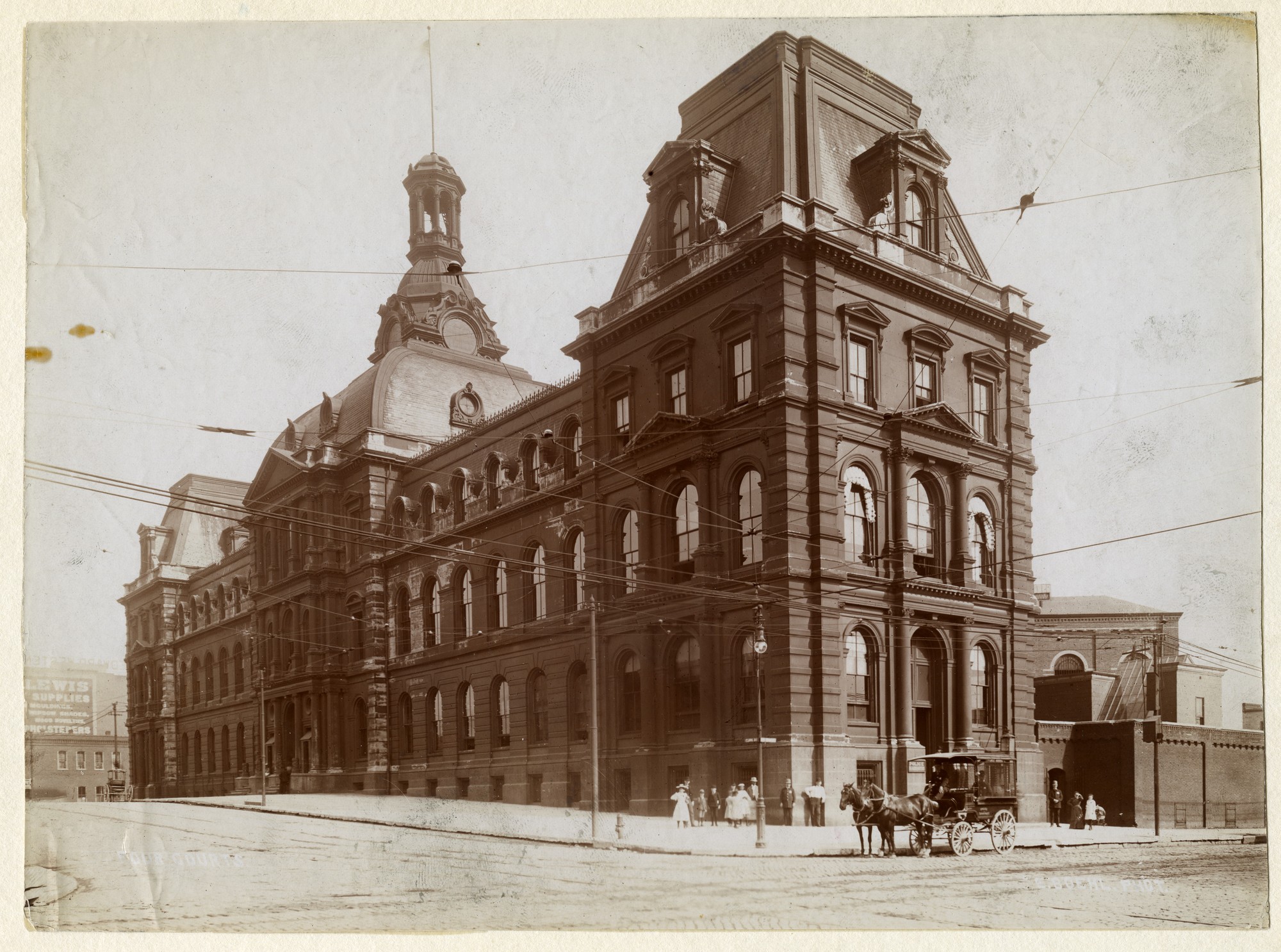
Meanwhile, the rich, along with the city’s politicians, got organized around Mayor Overstolz. They met to worry in the Four Courts Building — a police headquarters that resembled a castle of stone, outfitted with prisons in the basement. More arms were transferred to the stronghold to expand its existing storehouse. Mayor Overstolz told his frightened confidants that thirty thousand socialists were fully armed and equipped in the city streets. Since they didn’t have enough troops to arrest everyone and guard them as prisoners, the business elites called for a thousand volunteers to crush the strike.
When it appeared that Overstolz was wavering, the rich made their own plans. In the imaginations of the elite, the strike had expanded from a set of railroad wage disputes to a greater indictment of corporate capitalism overall. Only six years earlier, the First International had captured Paris and began the Commune, a revolutionary government that controlled Paris for months. Fears of the guillotine were real: The St. Louis rich began sleeping in their clothes, ready to flee or fight, and ordered their servants to do the same. They sent family to the countryside, and became paranoid that the workers would cut off the flow of water to their mansions. They filled the bathtubs, sinks, and every spare bottle in their Lucas and Vandeventer Place estates.
The violent red fever dream that was cooking up the Four Courts Building did not reflect reality. “Here in St. Louis the most violent doctrines of Communism are proclaimed, but no harm seems to be done by them,” the Globe-Democrat reported. The strike had not caused any destruction of property, and street cops refused to interfere with strikers as the action spread farther west across Missouri to Kansas City, Sedalia, and St. Joseph. As the Globe-Democrat reported, some law enforcement even sided with the strike: “A policeman was asked if he could not make any arrests. He laughed, and said as long as the railroad companies did not interfere with the men running the trains for them, it was none of their business.”
On Tuesday, six companies of federal troops arrived at the Union Depot. Three hundred marched with three Gatling guns. Many of them were African American soldiers, having won access to military service in Lincoln’s service. Now they were being deployed to crush a strike, which included Black roustabouts who’d won their right to a wage (for backbreaking dock labor) in the same struggle. “The same thing had occurred in other cities,” Mark Kruger writes, “where the government attempted to divide the poor according to race by using Black troops to break up strikes.”
Circumventing the mayor, the St. Louis businessmen who would later compose the Veiled Prophet Society formed the “Committee for Public Safety,” which had no legal status. The group was made up of financiers, manufacturers, railroad managers, and other white-collar elites who feared that the workers would soon abolish private property, and that the mayor wasn’t willing to kill enough of them to stop it. Without legal right, the committee took over the Four Courts Building and appointed two ex-generals — one Union and one Confederate — to raise a citizens’ militia. The St. Louis sheriff was directed to raise a posse comitatus.
Wednesday July 25, 1877, represented the apex of the national strike, which was broken by police violence: In Chicago and New York, police fired into crowds of workers, resulting in many dead and many more injured, weakening the national strike. Reports of gunfire in other cities did not deter St. Louis—on Thursday, the following day, sixty factories were shut down, and the crowd remained in firm control of the city. A flour mill was opened in order to provide bread for both the strikers and the general population of St. Louisans huddled into their homes, unsure about the strike, waiting to see what happens. The workers were starting to behave like a government, and offered the people of St. Louis an alternative with plenty of bread, and the trains up and running.
With the approval of the executive committee — including Peter Lofgreen, Albert Currlin, and Henry Allen of the Workingman’s Party — businesses began to reopen under the control of armed strikers so long as they complied with the demand for an eight-hour day. On Thursday, the owner of the Belcher Sugar Refinery came hat in hand to the executive committee asking permission to resume operating the plant — otherwise, a large quantity of sugar would spoil. The strike committee persuaded the refinery workers to go back to work alongside a guard of two hundred men to protect the operation. This was the people’s sugar, and the fulfillment of the ideological underpinning that guided the strike.
Each business that complied was noted, and after the strike was put down, “collaborators” were listed for public shaming in the Missouri Republican. The historian David T. Burbank writes that the Belcher episode represented “the spectacle of the owner of one of the city’s largest industrial enterprises recognizing the de facto authority of the executive committee.”
Historians refer to this as the “St. Louis Soviet,” a short-lived government in its own right. “The St. Louis papers used that term in horror,” Foner points out, but “they still took a certain pride in the claim that it was the ‘only genuine Commune’ established during the Great Strikes of 1877.”
The worst part of every strike story is the moment when the momentum shifts from David back to Goliath. “Having shattered the authority of the city and temporarily paralyzed the wealthy classes,” Foner writes, “the executive committee vacillated, hesitated, and fell back, unsure of what to do next. At the same time, it revealed that it feared the very mass movement it had helped to create.”
On Thursday, at the height of its power, the executive committee issued a statement urging its twenty-two thousand workers to go home. The railroad companies were refusing to negotiate, and elite calls for military intervention grew more panicked and paranoid. Skilled workers like the rail engineers didn’t want to lose their positions, and the strike leaders declared no more parades, no more speeches. They feared a riot, widespread looting, and arson. Meanwhile, thousands of militia were arriving at the Four Courts, and St. Louis gun stores turned their inventory over to the city fathers and the mayor.
As Kruger notes, in its war against the Commune, the Committee of Public Safety ransacked the city for weapons and supplies, illegally requisitioned property from citizens, and handed out vouchers to merchants, promising later reimbursement. As Black workers participated in more processions and mass meetings sponsored by the Workingmen’s Party, the Missouri Republican suggested that the movement was begin taken over by “notorious Negroes” who were acting under the “insidious influence of the International” to desecrate social values.
Much blame for the fracturing of the strike lies at the feet of Albert Currlin, who turned Black workers away, believing he could stoke the fires of the strike with white workers alone. Currlin called for arms and for people to enlist their neighbors in the fight, but as Foner writes, “one sure way of keeping Blacks out of mass meetings, and white workers from joining the Black workers, was not to hold any mass meetings at all!”
On Friday, having largely abdicated, the executive committee was reduced to pleading with authorities. They issued a public report that said there were no plans to arm the workers, and that rumors of that nature were “villainous falsehoods.” Those in the streets grew nervous and wanted arms to defend themselves against the militarized blend of militia, National Guard, and posse comitatus.
The St. Louis businessmen of the Committee for Public Safety operated under no delusion that violent conflict could ever be avoided. They raised $20,000 to arm the militia, and the St. Louis Gun Club contributed shotguns. A sheriff’s order in Friday’s Post-Dispatch threatened regular citizens of St. Louis with arrest and jail time unless they joined the sheriff’s posse and took up arms against the strike.
On the strength of 1,500 rifles that came from the state arsenal, the militia ousted the strike’s leadership from their headquarters in the Hyde Park Turner Hall. Mayor Overstolz warned the strikers against closing any more factories, and the railroad manager, Wilson, wired Washington, DC, “Time has come when the President should stamp out mob now rampant … The law can be found for it after order is restored.”
Two thousand strikers congregated at the secondary headquarters, Schuler’s Hall, to demand rifles from the executive committee. The Missouri Republican quoted a Black striker who wanted arms turned over to “a company of colored men” who would guarantee that the strike would end quickly and victoriously. The crowd agreed and cried out that the issue was “whether the poor man was going to get any show at all of his rights.” The executive committee refused the call for arms.
At three o’clock in the afternoon, a police cavalry led by Captain Fox marched on Schuler’s Hall. Behind the cavalry were two files of foot police with bayoneted muskets and a cannon that “showed grimly near the middle of the force,” a Missouri Republican reporter wrote. At the rear of the company was Mayor Overstolz and members of the Committee for Public Safety — this was the first iteration of the Veiled Prophet Society.
Mounted police charged into the crowds at Schuler’s Hall. Thousands of innocent spectators were attacked by swinging clubs, with police aiming for any skull within reach. Three thousand federal soldiers plus five thousand deputized “special police” were deployed.
Police horsewhipped the crowd, and one man was trampled by a horse. Orders were to shoot anyone who resisted, and while many were arrested, only forty-nine stayed in custody.
Hundreds were dead nationwide. In St. Louis, authorities bloodied many workers — and some sources list casualties from skirmishes around the city—but for the most part, the Great Strike in St. Louis occurred without loss of life. As Burbank notes, “The only bloodshed occurred when one of the militiamen slipped off a windowsill of the Four Courts, where he had been sunning himself, and scratched himself on his own bayonet.”
Forty-nine leaders of the Workingmen’s Party were arrested at their headquarters and marched to the Four Courts to be locked up in the jails. Others escaped and fled the city. On Saturday, the East St. Louis Relay Depot was retaken, and the local press wrote the final words: They accused the strike leadership of incompetence and declared that the week had been a failed revolution. The workers were described as lazy, lavish spenders with “beetle brows.” “The Communistic uprising had died through decapitation,” wrote the Globe-Democrat, “and the police succeeded in driving the rank and file of the movement to their holes.”
Many small fines were issued for “disturbing the peace,” and some workers were sentenced to six months in the city workhouse — the same charges and punishments allotted to civil rights leaders a century later. Strike leaders like Lofgreen and Currlin were charged with felony rioting, which were dismissed in court that August for lack of evidence.
On the Tuesday following the strike, leaders of the St. Louis business community sponsored a vast military parade. Over five thousand armed men marched with sidewalks packed with onlookers. The business elites of the “leading enterprises of St. Louis” marched too. “The display of military force is a solemn warning to Internationalism, Communism and all other forms of disturbing ‘isms,’” wrote the Globe-Democrat.
Over the subsequent century, the history of the railroad strike would be officially suppressed and forgotten in public memory.

A year after the Great Strike, 20 letters arrived on 20 desks across St. Louis, inviting captains of industry to “attend a meeting of prominent gentlemen” whose objective was to promote “the interests of St. Louis.”
In early July of 1877, Alonzo Slayback was out of town during the strike. He’d been occupied by an intense legal battle within the Bar Association, a conflict that somehow dissipated or was rendered moot as he left St. Louis for vacation in Minnesota around the start of the St. Louis Society. His travel plans were listed in the newspaper.
A year after the big strike, on October 6, 1878, amid a new trolley workers’ action, the engraved stamp image of the Veiled Prophet appeared in the Missouri Republican. This was Slayback’s “stroke of genius,” as he put it in his diary the night before. “The above steel engraving represents the original Veiled Prophet himself,” the paper read. “The artist has caught very cleverly the expression of benignant firmness on his countenance, and shown with rare fidelity the dignity of his attitude.”
The character in the image is a clown-like figure armed with a rifle, a pistol, and a bowie knife tucked in his white-cloak waistband. He has a triangular nose and wears a conical hat. A white handkerchief is wrapped around his neck, and a third rifle is leaned against the darkness of the black background, well within reach. The etching of the first Veiled Prophet is sending a clearly hostile message, and the article confirms this, clarifying that the Prophet will soon mount chariot, and parade through town. “It will be readily observed from the accoutrements of the Prophet that the procession is not likely to be stopped by street cars or anything else.”
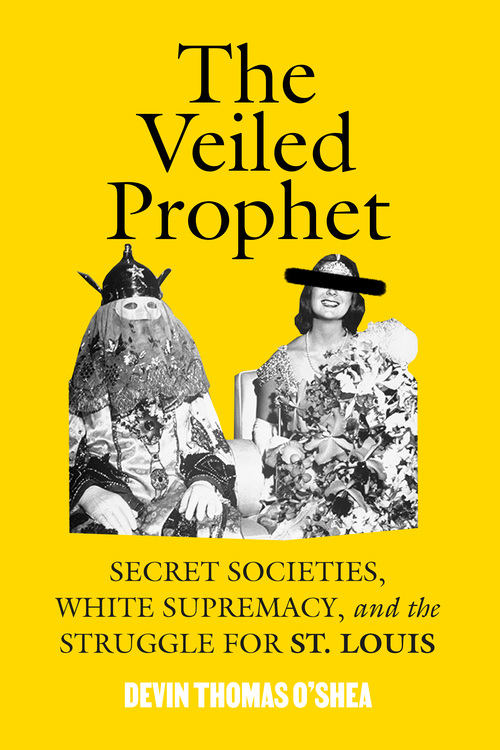
In the years that followed, the Veiled Prophet would become the central mascot of the St. Louis elite. He would be misinterpreted as a Santa Claus character, or an old wizard who presides over a traditional debutante ball, but the Veiled Prophet’s true origins are as a Ku Klux character. He was invented and deployed from a place of fear and uncertainty, and was a direct response to the St. Louis Commune — an interracial show of force by the city’s workers.
Reprinted with permission from The Veiled Prophet: Secret Societies, White Supremacy, and the Struggle for St. Louis by Devin Thomas O’Shea, published by Haymarket Books. © 2026 by Devin Thomas O’Shea. All rights reserved.