
The Sweets of Peace and Domestic Happiness
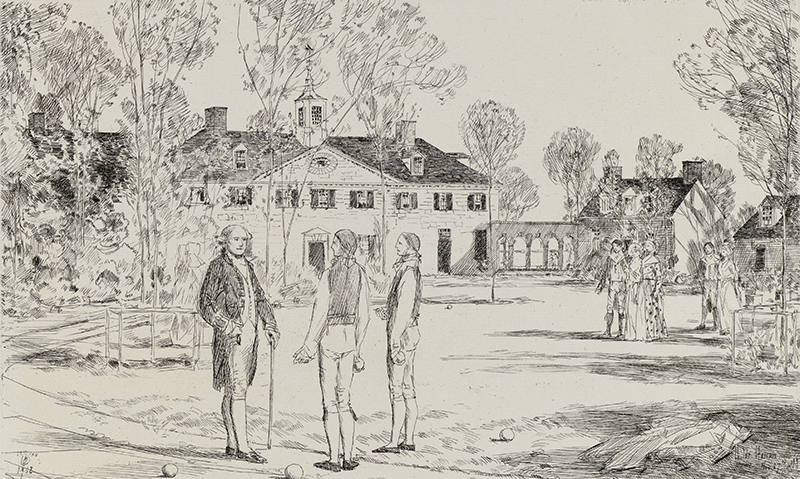
Mount Vernon, 19th century. [Smithsonian American Art Museum]
For many people, the experience of living through the American Revolution was a deeply distressing, traumatic ordeal, one wracked by inner turmoil, fear, and insecurity. These emotions manifested most palpably in domestic life. Unable to shield their families against the violence of war and occupation, many men worried that their own actions had endangered their families. “Twas Death to leave you, twas worse to stay,” Massachusetts loyalist Benjamin Pickman wrote to his wife in July 1775; still, he confessed, “I some Times blame myself for having left you and my Family.” Pained by his family’s situation in the Philadelphia garrison, Henry Drinker worried how they managed in his absence, particularly his wife. “I should think it my duty and business to have inserted my mean capacity and weak abilities to ease and soften thy anxieties and cares … had I been permitted to have remain’d with my dear Family,” he professed. Letters from home detailing wartime hardship only exacerbated these concerns, causing many men to feel frustrated and helpless as their families suffered. They longed to return home, if only to relieve their wives’ burdens and soothe their children’s fears. “It would be a Joy to me to fly home, even to share with you your Burdens and Misfortunes. Surely, if I were with you, it would be my Study to allay your Griefs, to mitigate your Pains,” one Massachusetts man professed to his wife during the British occupation of Boston.
Shouldering sole responsibility for childcare, subsistence, and the welfare of their households and family businesses amid the chaos and uncertainty of war — at times with British officers quartered in their residences — many white women also experienced the Revolution as a prolonged period of anxiety and emotional distress. “Tedious days Melancholly nights,” Mary Gould Almy lamented from Newport in 1778; “I wonder what keeps me alive.” By lonely firesides, women gathered their children in their laps as cannons echoed overhead and windowpanes rattled around them. Burying their own apprehensions, they reassured anxious daughters and sons that their fathers would be home soon — even as they increasingly referred to themselves as widows in their own minds. Separation, Sarah Redwood Fisher admitted, was “very hard to bare.” Crying into their pillows, women dreamed of embracing their husbands and fervently wished for the safe return of their partners. Letters offered momentary consolation, but they were “a cold comfort in a winters Night,” especially as letters were often guarded, constrained by the knowledge that correspondence was carried unsealed across military lines and open to prying eyes. “The open manner in which our letters are sent, prevents the feelings of the Heart being properly express’d,” Elizabeth Drinker regretted during her husband Henry’s exile. Still, the couple’s children treasured these stilted communications. Seven-year-old Henry memorized the letter his father wrote to him. And three-year-old Molly, after listening attentively to the parts of her father’s missive addressed to her, went up to her mother “without speaking, with her mouth held up by way of demanding the Kiss [her father] sent her.”
The end of the war meant that, at long last, these desires for reunification could be made real. Peace promised an end to uncertainty and separation, to loneliness and fear — for white families, at least. It meant that they no longer worried about soldiers knocking at their door to request quarters or being awakened in the middle of the night by armed men ransacking their homes. It meant an easing of the daily hardship of subsistence and survival, a return to bustling markets and abundant crops. For women of all races, peace lessened — though certainly did not alleviate — the threat of rape and violence that shaped the way they moved through their neighborhoods as they navigated life under military occupation. Nearly six months to the day after the British evacuated Philadelphia — having spent much of the previous year pregnant, caring for an infant and a toddler while separated from her husband —Sarah Logan Fisher enjoyed a contented evening at home with her “beloved” husband and “our sweet Children.” “May we be sensible of the Blessing and favour of being united together and having two such sweet pledges of our mutual Love,” she reflected in her diary; “it seems a Happiness almost too exquisite to last.”
For white men and women alike, peace promised the one thing that many families had longed for during the war: “domestic Happiness.” In the postwar years, Americans embraced their families with vigor. Some elite white women, especially those of the younger generation, like Lucy Knox, wife of Continental major general Henry Knox, were nevertheless reluctant to relinquish the domestic power they had wielded during the war. “I hope you will not consider yourself as commander in chief of our own house,” Lucy insisted, declaring, “There is such a thing as equal command.” But such women were, in many ways, outliers. War had exposed the fault lines in traditional household arrangements and left many women vulnerable. Eager for a return to normalcy, many white women were happy to retreat from the position of household head on their husbands’ return. After all, they realized, there was protection in dependence. “All my desires and all my ambition is to be Esteemed and Loved by my Partner, to join with him in the Education and instruction of our Little ones, to set under our own vines in Peace, Liberty and Safety,” Abigail Adams avowed. Family life, free from the burdens and fears of war, was an alluring prospect after years of separation, hardship, and anxiety. Writing to his wife, Mary, from whom he was separated for nearly a decade, Benjamin Pickman expressed his desire to “pass my Days in Tranquility at Home” with his family. “For the remaining Part of my Life I shall be only a Spectator,” he promised; “I am determined to preserve my Mind unruffled should I see the Whole Fabrick of Nations crumbling to Pieces.” The fruits of liberty were to be found in domestic tranquility.
Indeed, in the introductory preface to her 1805 History of the Rise, Progress, and Termination of the American Revolution, historian Mercy Otis Warren invoked these shared remembrances of domestic warfare to soften readers’ prejudices toward a history of war authored by a woman. “Doubtless it is the more peculiar province … of manly eloquence, to describe the blood-stained field, and relate the story of slaughtered armies,” she acknowledged. Yet, she argued, the warfare of the American Revolution had not been limited to “the blood-stained field.” It had been a war waged on city streets, among civilian communities, and within American households. “The horrors of civil war rushing to habitations not inured to scenes of rapine and misery; even to the quiet cottage, where only concord and affection had reigned; stimulated to observation a mind that had not yielded to the assertion, that all political attentions lay out of the road of female life,” she explained. The war’s intrusion into the most intimate domains of American households affected men and women alike. Foregrounding this perspective, she hoped, would resonate among readers. For as Mercy Otis Warren acutely understood, for many citizens of the new United States, the trauma of the American Revolution was fundamentally entwined with domestic life.
Both during and after the Revolution, white Americans invoked the biblical image of the vine and fig tree to express their hopes for peace, domestic bliss, and freedom from fear in the new nation. Derived from Micah 4:4 — “Every man under his vine and under his fig tree; and none shall make them afraid” — the metaphor was not new in revolutionary circles. As early as 1769, colonists adopted the phrase to draw explicit connections between revolutionaries’ efforts to secure political liberty and the sanctity of their domestic lives. During the early years of the imperial crisis, the metaphor conveyed the invasive nature of taxes and fears of search and seizure, but the experience of war and British occupation gave new awareness to the meaning and consequences of domestic invasion. After the outbreak of war, the notion of a secure domestic refuge became both a distant memory and a hope for the future that conveyed both long-awaited familial reunions and the promised blessings of liberty. As Virginia delegate to the Continental Congress George Mason fervently wished in 1776 amid the throes of war, “May God grant us a Return of those halcyon Days; when every Man may sit down at his Ease under the Shade of his own Vine, and his own fig-tree, and enjoy the Sweets of domestic Life!”
Perhaps no American revolutionary invoked the imagery of the vine and fig tree more frequently than George Washington. The metaphor is pervasive throughout the general’s personal correspondence, especially as the war drew to a close. Awaiting word of the final peace treaty in October 1783, he expressed his “a[n]xious desire to quit the walks of public life, and under the shadow of my own vine, and my own Fig-tree, to seek those enjoyments, and that relaxation, which a mind that has been constantly upon the stretch for more than eight years, stands so much in need of.”
Aligning with many peoples’ own desires for domestic tranquility, Washington’s well-known love of private life and his long-desired homecoming endowed his beloved Mount Vernon with outsized significance in the young Republic. Throughout the country, Americans celebrated General Washington’s triumphant return to his plantation, heralding him as the American Cincinnatus, an allusion to the Roman general who relinquished power and retired to his farm after defeating a tyrant. “Without Mount Vernon, the comparison to Cincinnatus would not work,” one Washington scholar has argued; “the public had to understand the private world Washington left and returned to in order to appreciate his sacrifice.” Symbolizing George Washington’s long-awaited retirement, Mount Vernon loomed large in the popular imagination as a peaceful retreat where the conquering hero returned home to reap the fruits of his sacrifices to the nation. The plantation, scholars have argued, was “the tangible embodiment of his independence,” both as an autonomous landholder and a citizen of the new United States; the hero’s return to his safe, protected household symbolized both the sacrifices of war and the hopes of the nation. War and British occupation had demolished colonists’ conception of houses as castles; but, in the aftermath of the Revolution, Mount Vernon provided a new symbol for the nation to rally around: the tranquil, independent household as the reward for white Americans’ wartime sacrifices and patriotism — without the troublesome monarchical metaphor.
Enshrining domestic life as a critical pillar of American independence, the public veneration of Mount Vernon signified the emergence of an incipient “secular American culture and identity” centered around the private home. Reflecting many Americans’ own desires for domestic tranquility in the aftermath of civil war, the Washingtons’ private retreat became a public spectacle in the early years of the Republic. Visitors made pilgrimages to Mount Vernon to observe the victorious general and partake in the fruits of his victory.
As the Washingtons and their numerous enslaved laborers entertained these visitors, they performed republican independence and American domesticity for an eager public. These enactments, which were also circulated in print form, notably Edward Savage’s depictions of George Washington — clad in his military uniform, strolling on the west lawn of Mount Vernon, and gathered around the table with his family (with enslaved laborers in both images hovering near the edges of the frame) — lauded both the general’s domestic retirement and the idealized postwar household.
This public obsession with Mount Vernon helped cement the relationship between private domesticity and American independence in the national consciousness. Mount Vernon, with its classically inspired, republican simplicity — that maintained the racial and gender hierarchies of the plantation household — offered a model of American architecture and American households at a time when most other publicly identifiable buildings were vestiges of British rule. George Washington’s unique position as the general who won American independence, as the nation’s first president — as the father of the country — meant that Mount Vernon also came to be the nation’s home, a widely recognizable, uniquely American symbol that united the nascent Republic. Printmakers and engravers throughout the nation reproduced Savage’s images of Mount Vernon, circulating them for popular consumption. By the end of the 18th century, these images of Mount Vernon proliferated to an unprecedented degree, appearing on mass-produced clocks and ceramics.
In purchasing these items, American citizens could bring Mount Vernon into their own households, emulating the general’s domestic felicity beneath their own vines and fig trees. Within the popular imagination, Mount Vernon not only came to symbolize the fruits of victory, it actively modeled the practice of independence in the new Republic.
And so, perhaps it is unsurprising that, in the years after the war, white American men reclaimed their households, where they, like Washington, planned to enjoy the fruits of independence under their own vines and fig trees, surrounded by their families and “enjoy[ing], without molestation, the sweets of Peace and domestic happiness.” The resumption of domestic life, free from fear, was integral to how many white Americans envisioned their newfound independence. After eight long years of war, familial separation, and hardship, revolutionaries reveled in their hard-won domestic tranquility, secure in the belief that their residences were safe from the invasions and violations of the war years. As officials in Schenectady, New York, proclaimed in June 1782, “We anticipate the glorious period when the Voice of War shall be at an end, when the Inhabitants of our Bleeding Country, shall be enabled to sit under their Vines and Fig-Trees, and no savage foe to disturb their Rest.”
During the 1780s and 1790s, domestic life found its way into national politics as a symbol for American independence precisely because it resonated among a war-weary populace — many of whom had already embraced domestic tranquility as their reward for wartime hardship. “There is no part of the earth where so much” domestic happiness “is enjoyed as in America,” Thomas Jefferson enthused in 1788. Domestic felicity, Americans agreed, was uniquely entwined with the character of the new nation. No other country, Abigail Adams proudly proclaimed, “Boast[ed] that first of Blessings, the Glory of Humane Nature; the inestimable privelege of setting down under their vines; and fig trees, enjoying in peace and security what ever Heaven has lent them; having none to make them affraid.”
So pervasive was this association of domestic tranquility with the American nation and the American character that, by 1797, as American officials drew up plans for new peace medals to be distributed in diplomatic exchanges with Indigenous nations, they chose scenes representing domestic life. Designed by Continental veteran John Trumbull, the three medals, collectively known as the “Season Medals,” were struck in 1798 to commemorate Washington’s second presidential term. Trumbull’s motifs depict idealized domestic scenes: a farmer sowing his fields with a rustic cabin in the background; a shepherd overseeing his herds; a woman spinning by the hearth with her children — one in a cradle, one playing at her feet — and another woman, weaving in the background, while a teakettle boils. Intended to both encourage assimilation and to convey the authority and power of the new nation, the peace medals were proclamations of identity.
Domestic life, they made clear, was vital to the practice of independence, to American nationalism, and to projections of state power.
From The Home Front: Revolutionary Households, Military Occupation, and the Making of American Independence by Lauren Duval. Copyright © 2025 by the Omohundro Institute of Early American History and Culture. Used by permission of the University of North Carolina Press.
Want to keep reading about the 250th? Here is Bruce W. Dearstyne on how Calvin Coolidge celebrated the United States’ 150th anniversary, Marc Egnal on the historiography of the causes of the American Revolution, Robert A. Gross on why we call it the “American Revolution,” and Marc Stein on 1976. Find even more to explore on Bunk.