
Where Lies the Revolutionary Soldier?
Headstones of the 12 Unknown Continentals of the Camden Fourteen at the Old Presbyterian Cemetery in Camden, South Carolina. [FHD Forensics]
For the ordinary soldier of the American Revolution, memorialized by neither statue nor monument, grave sites offer a rare opportunity for remembrance. Yet more than 250 years after the outbreak of that war, many of those graves remain obscure. They are hidden beneath battlefields where the fallen were hastily covered in the ravaged earth or below barely legible markers. Amidst the more prominent recent commemorations of our nation’s beginnings, there have been quiet efforts to care for and give visibility to these final resting places. This work reveals not only the human cost of the Revolution, but also the lived experiences of soldiers who didn’t make it into the history books — and what veterans did after the war’s end to help build a new nation.
In the Midlands of South Carolina, the site of one of the Revolution’s bloodiest battles, a team of preservationists is attempting to honor the soldiers who died there. The clash between the British and the Continental Army on August 16, 1780, known as the Battle of Camden, ended in pandemonium. The Americans, led by Major General Horatio Gates, had marched for days on little food, with dysentery plaguing their ranks. A large number of the soldiers were inexperienced, and quickly fled the British onslaught; Gates himself abandoned the battlefield in the mass retreat. But others held their ground, among them the 7th Maryland Regiment. Many fought hand-to-hand to the death even as defeat proved certain. Their stand allowed the American forces to avoid complete destruction.
Archaeologists Steven D. Smith and James B. Legg have spent decades mapping and interpreting the battle site, where the soldiers’ mass graves have become increasingly vulnerable to erosion and looting. In 2022, with the South Carolina Institute of Archaeology and Anthropology at the University of South Carolina (USC-SCIAA) and the South Carolina Battleground Preservation Trust, the team finally excavated 14 soldiers from a disturbed grave. The soldiers were reinterred with military honors in 2023 at Camden’s Old Presbyterian Cemetery. But the mystery of who they were lingered. Texas-based FHD Forensics, which specializes in identifying John Does, was invited to help determine their identities.
“These remains were endangered,” said Allison Peacock, FHD Forensics’ founder and president. “They were sticking up out of the ground; people were taking metal detectors out there and digging into the graves to get buttons out of them. The thought was that these men deserved better than that, and if we’re going to rebury them, we should try to put their names on their headstones.”
FHD Forensics was able to extract one soldier’s DNA from a small piece of his skull, which was sequenced by Astrea Forensics in California with the support of the USC-SCIAA Archaeological Research Trust.
“The paleogeneticists at Astrea Forensics are used to working with really old DNA every day, even 10,000-year-old mummies,” Peacock said. “So 240-year-old remains for them were not a big deal. Yet they had never been asked to create a genetic genealogy file for 240-year-old remains.” It took several tries to “get enough DNA to create the whole genome to make the profile,” but the experiment worked.
Genetic genealogy is relatively new to archaeology. In 2018, the subfield had its moment of fame when an open-source genealogy website was used to identify the Golden State Killer. Efforts to compare the Camden soldier’s profile to potential database matches for ancestors were combined with an intensive archival investigation into court records, tax documents, land patents, and anything else that might have traces of family names. The researchers were ultimately able to connect the bones to John Pumphrey, who had enlisted in the 7th Maryland Regiment in Baltimore as a teenager in January 1777. The identification was announced by FHD Forensics this June at a small Baltimore gathering they organized that included descendants of Pumphrey’s family.
“Most of the Army’s records were lost that day due to the chaos of the battle and the general literally leaving the field,” Peacock said. According to the National Park Service, Gates rode almost 200 miles over three days in the retreat. (Alexander Hamilton quipped in a letter, “It does admirable credit to the activity of a man at his time of life. But it disagraces [sic] the General and the Soldiers.”) Peacock added that the “fact that we had our first subject Private John Pumphrey’s name on a muster roll was a miracle.”
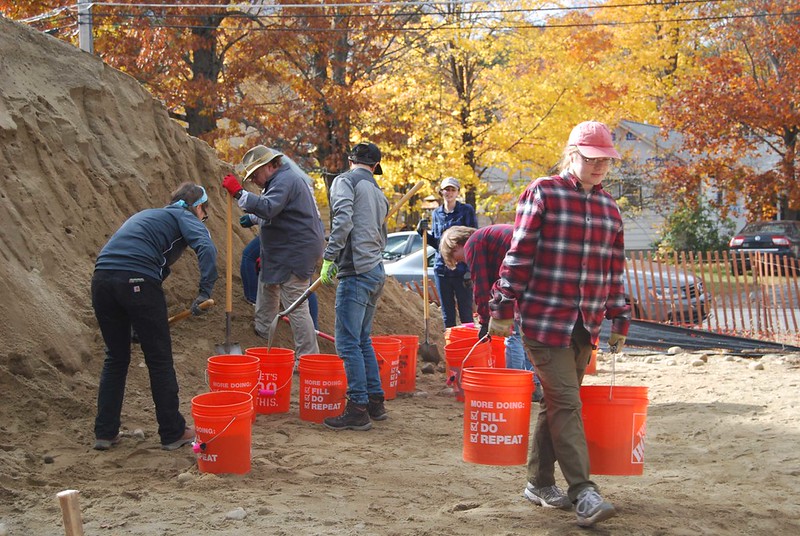
It’s not unusual for Revolutionary burials to be concealed underneath the development of the country that followed. In February 2019, construction workers in Lake George, New York, found human bones and grave shafts as they dug out the foundation of a new apartment building. In the months that followed, the site was linked to a makeshift hospital that the Continental Army set up during its unsuccessful 1775–76 Quebec Campaign to establish a 14th colony in Canada.
“It was an event that wasn’t lost to history, but it had been overshadowed by other events that occurred in Lake George,” said Lisa Anderson, a recently retired New York State Museum curator of bioarchaeology who continues to serve as a volunteer and research associate at the Albany institution. Lake George, at the southern edge of the Adirondacks, is better known for its role in a 1755 battle in the French and Indian War. The less dramatic story of soldiers who were buried on a hillside overlooking the water after dying in isolation during a smallpox epidemic couldn’t compete in the region’s historical memory. But considering the lives of the young soldiers cut down not on the battlefield, but rather by disease, offers an illuminating angle on history that often gets forgotten.
Although the exact number of American casualties in the Revolutionary War is hard to pin down, the American Battlefield Trust estimates that roughly 6,800 soldiers were killed in action. Historians have tallied some 17,000 additional deaths from disease. Close quarters, poor sanitation, a lack of medical training for military doctors, and regular outbreaks of smallpox, cholera, typhus, and other diseases made for grim conditions at hospitals like the one at Lake George. “It’s another aspect of the conflict and war that is sobering,” said Anderson.
Anderson explained that although the dead “were buried with as much care as possible given the circumstances,” over time any mounding or marking became invisible. Sifting through the truckloads of dirt removed from the construction site, in which 18th-century skeletal remains were jumbled together, was a staggering task. It involved around 140 volunteers and archaeologists with the New York State Museum, and the state’s Department of Environmental Conservation and Office of Parks, Recreation, and Historic Preservation. The discovery of pewter uniform buttons marked “1BP,” indicating the 1st Pennsylvania Battalion, was a breakthrough.
“The buttons gave us certainty that the graves were associated with the American Revolution and, very likely, the hospital,” Anderson said. “Few other personal items were found, but as a hospital cemetery, most of the individuals would not have been buried in their uniforms. Had we not found the buttons, we might not have put it all together. We estimate that there were at least 44 individuals whose graves were disturbed; they were literally in fragments in a pile of soil the size of a house. The whole idea of sifting the pile was a little crazy, but we felt strongly about it. It took us about 15 months.”
Those 44 individuals included a woman and a child, a reminder that soldiers’ families regularly came along on military campaigns. Archaeologists at the New York State Museum studied the bones, and managed to create a facial reconstruction of one soldier. In May of this year, the remains were placed into wooden caskets that were carried in a motorcade of historic military vehicles back to Lake George, where they were reinterred at a new Repose of the Fallen memorial in Lake George Battlefield Park.
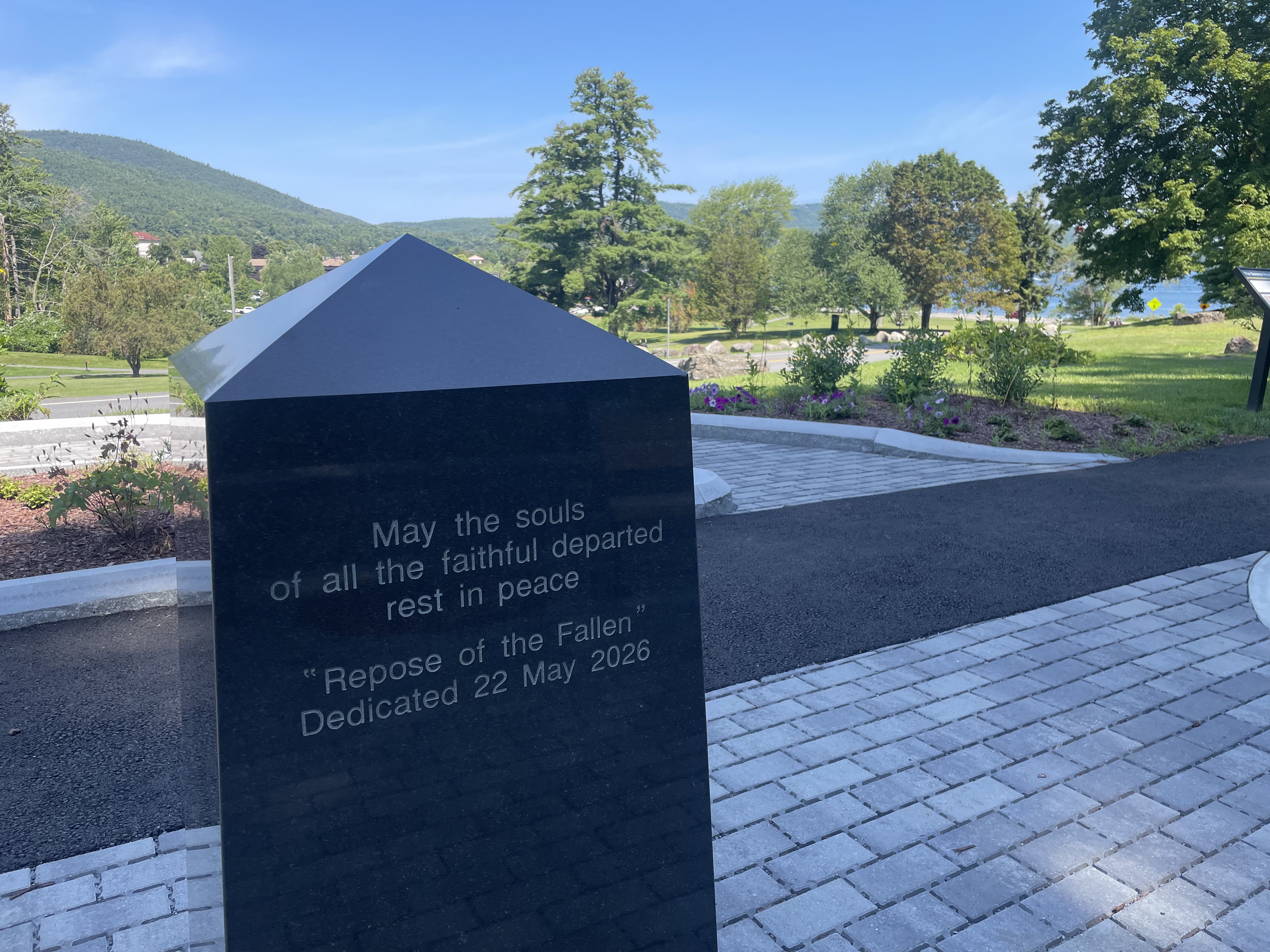
Meanwhile, researchers continue to parse their observations of the bones.“We’re still in the process of going through the data collected from all the fragments from piecing things back together,” Anderson said. “We expect to continue to learn more about the cemetery and those buried there. We’ve not written the final chapter on this yet.”
Up until a few years ago, New York was one of four states without legal protections for unmarked graves. Spurred by cases like the Lake George discovery, state lawmakers in 2023 passed the Unmarked Burial Site Protection Act. The legislation makes it a felony to intentionally destroy a burial site, and sets protocols such as halting work if remains are found. It’s believed that hundreds of people died at the Lake George hospital, and the new law will help protect any future finds there — or elsewhere in the state. Just months after the new law was passed, an 18th-century human skull was discovered in Lake George during work on a gas line; work was stopped before it could be churned up with the dirt.
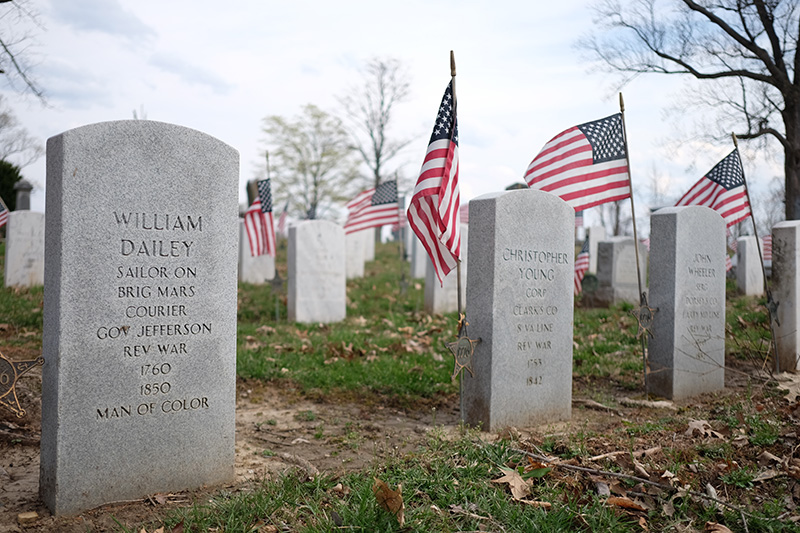
Even graves with markers are under threat of disappearing. National military cemeteries and formal systems for memorializing veterans were not created until the Civil War. Veterans of the American Revolution were interred using whatever resources their families had. Even when a granite or marble headstone could be afforded, it is likely to have deteriorated or been damaged over the years. To address this situation, the Ohio History Connection and the State Historic Preservation Office launched the Revolutionary War Veteran Graves Project in the spring of 2025. The crowdsourcing campaign sought to document Revolutionary War veterans, potentially more than 7,000, buried in the state.
“Most of the veterans passed away in the 1820s and 1830s, so there are few structures associated with them anymore; their houses are long gone for the most part,” said Krista Horrocks, the project manager for the initiative with the Ohio History Connection. “Their gravesites are really all that’s left of them and their legacy.”
These grave markers, which are some of the oldest in the state, preserve the names of individuals involved in the lesser-known story of the opening of settlement in the Northwest Territory following the war. In the Ohio region, land was reserved specifically for veterans, the amount given based on rank. It was where many who fought forged new lives.
“Supposedly, more Revolutionary War veteran officers are buried in Washington County, Ohio, than anywhere else in the country,” said Horrocks. Mound Cemetery in Marietta, a city whose founders included several Revolutionary War officers from New England, has 37 known veteran graves. “I think a lot of people have no idea that we have this connection.”
The project builds on burial data collected during 1970s bicentennial efforts, when organizations such as the Sons of the American Revolution and Daughters of the American Revolution created indexes of marker and grave locations. Using a dashboard of digitized burial records and a smartphone app for collecting survey data, volunteers in Ohio captured inscriptions, photographs, and GPS coordinates to record their current conditions. The project significantly improved the visibility of these graves both in terms of collecting recent photographs and putting them on the radar as part of public history; many participants reported visiting their local cemetery for the first time. More than 570 volunteers took part, recording more than 4,300 gravesites.
.jpg)
The project’s initial findings were released on July 4, 2026, and included an interactive digital map that will continue to be updated. Organizers are hoping to turn their attention next to graves that lack an exact known location within specific cemeteries. “We want this to be a living document, so it will keep being revised, and the hope is that someday, some of the gravesites that have been lost can be found,” Horrocks said.
The remains of some Revolution veterans are now buried in places where they were not initially interred. They were transferred to one of the many sprawling, garden-like cemeteries promoted by the 19th-century rural cemetery movement to provide more dignified resting places, particularly in urban areas where old colonial churchyards were considered health hazards due to their festering layers of bodies. Mount Auburn in Cambridge, Massachusetts, was the first of these new cemeteries. It was established in 1831 as a rustic respite that, unlike the grim burial grounds of the time, could be a place of civic pride that would uplift the spirits of visitors.
“The founders were hoping to provide a space of burial for the dead that was for commemorating good citizens of a new country,” said Corinne Elicona, Mount Auburn’s education and digital content manager. “It was about rethinking monuments and people’s legacies and memories in a different way than Americans had before the Revolution.”
It was an ethos proclaimed by Mount Auburn’s first president, Joseph Story, at the cemetery’s dedication on September 24, 1831:
Here let the brave repose, who have died in the cause of their country. Here let the statesman rest, who has achieved the victories of peace, not less renowned than war.
As part of this year’s 250th celebrations, Mount Auburn created an online portal focused on the graves from this era, spotlighting how many families chose to rebury their dead in the cemetery from Boston graveyards.
“You’re having this changing of taste in the society at large where families were looking at worn-down, broken stones in the crowded colonial-era burial grounds, and saying, well, what if we had a family lot in this new type of cemetery, this picturesque romantic setting,” Elicona said.
These new cemeteries were also collective spaces for expressing a still-forming national identity. Neoclassical monuments with columns, urns, and drapery carved in marble aligned the United States with the ancient democracies of Greece and Rome. Mount Auburn’s bucolic landscape features the Washington Tower, an observation structure built in the 1850s that doubles as a cenotaph for George Washington.
“People tend not to think of the Victorian-era cemeteries as places of Revolutionary history, and that’s not always accurate,” Elicona said. “Not only is the Revolution affecting the 19th-century mythmaking of the United States, it’s also affecting how people are being buried.”
With the mass graves of the battlefields still recent history, this new kind of cemetery could offer permanence and beauty, showing that the United States would be a place where the dead were honored in a way they had often not been in the past. Now, with the heightened awareness about those who still rest beneath the earth, unmarked and unknown, there is the potential to bring more attention to the sacrifices made by so many individuals in the American Revolution. Some may never be found, and some names are likely gone forever. By tending with care to those graves that endure or are rediscovered, we can help ensure that this history will not be forgotten.
Want to keep reading about the 250th? Here is Denver Brunsman on Young Washington, Bruce W. Dearstyne on how Calvin Coolidge celebrated the United States’ 150th anniversary, Marc Egnal on the historiography of the causes of the American Revolution, Robert A. Gross on why we call it the “American Revolution,” Lauren Duval on the “fruits of liberty” found in “domestic tranquility,” and Marc Stein on 1976. Find even more to explore on Bunk.